
The teeth of people living in care homes in England are being left to rot, dentists say.
The warning comes after the Care Quality Commission found that residents did not always have access to dentists and were not getting the support they needed to look after their teeth.
Its inspectors visited 100 homes caring for elderly and disabled people.
It comes as the British Dental Association highlighted a number of distressing cases of decay and neglect.
How the vulnerable are being failed
These included a blind, 93-year-old woman with advanced dementia whose dentures had become stuck in her mouth because they had been left in for weeks and her gums had grown around them.
She was taken to A&E and the dentures had to be surgically removed.
Another case involved a woman with learning disabilities who was found to have huge amounts of decay and gum disease, including one tooth that had virtually rotted away.
It was only spotted because she had stopped eating.
Charlotte Waite, from the British Dental Association (BDA), said it was distressing that some of the most vulnerable people in society were being failed in this way.
“The teeth of many care home residents are being left to rot thanks to a system that fails to view their oral health as a priority.
“We require nothing short of a revolution in the approach to dentistry in residential homes.”
What is the problem?
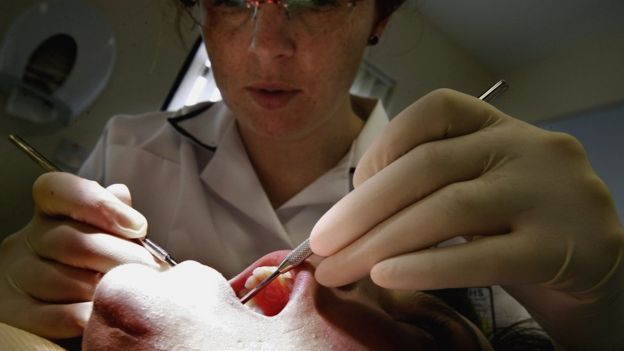
The CQC report – based on visits to 100 care homes – highlighted both a lack of access to dentists and insufficient support provided by care home staff.
Around half did not provide training to their staff on oral health care, while nearly-three quarters of individual care plans did not cover oral health sufficiently.
One in six care homes also said they did not assess residents’ oral health on admission.
One in three said they could not always access dental care.
This was mainly related to the lack of specialist dental services that visit people in the community rather than expecting them to attend clinics.
Research by the BDA has found the NHS is only paying for a fraction of the services it needs.
Around eight per cent of the general population is classed as “severely limited”. Not all of these will need a specialist dental service, but many will.
However, figures obtained by the BDA under the Freedom of Information Act have suggested only one to two per cent of this population are given access to such services.
Kate Terroni, from the CQC, said the NHS, care sector and dentists needed to work together to address the problems.
She said oral health could not be treated as an “afterthought” as problems with teeth could leave people in pain, unable to eat and lacking confidence.


