Mr Abudulai Bajuuri, the Wa East District Best Farmer for the 2020 farming season, has advised farmers to observe Good Agronomic Practices (GAPs) in their farming activities in order to benefit from their sweat.
He said he had personally been following the advice from Agricultural Extension Agents on proper farming practices and appropriate crop variety to plant, which had benefited him tremendously.
Mr Bajuuri gave the advice in an interview with the Ghana News Agency (GNA) at Guonuo in the Wa East District at the weekend after the occasion of the 36th Farmers Day celebration.
The event, which was on the theme: “Agribusiness development under covid-19 – Opportunities and challenges”, saw the Wa East District Assembly awarding 18 farmers, while the Sissala Rural Bank and Vision Farms also awarded eight farmers.
“I don’t refuse advice, when the agric workers come here and say anything that we should do this and that or we should plant this type of crop that is what I do. That is what has helped me,” 41 years old Mr Bajuuri explained.
He also advised the general public against bushfire, saying they could destroy farm produce, and in turn affect the economy of the farmer as well as affect human life.
On her part, 28 years old Amamata Sahanun, the winner of the District’s Best Woman Farmer category, advised women farmers to inculcate the habit of saving to help them to improve their farming activities.
“As a woman I do not have the strength like a man to farm. Because of that I engage labourers to do almost everything for me. When I harvest, I store some of the produce and sell them when I am ready to farm, so I always have some money to pay for the labourers,” she explained.
Madam Sahanun stated that due to the Planting for Food and Jobs programme, they had access to fertilizer at affordable prices which had enabled them to expand their farms.
For his award, Mr Bajuuri received a tricycle, knapsack sprayer, wellington boot and a cutlass, while Madam Sahanun took home a “rubber rubber” motorbike, knapsack sprayer, wellington boot and a cutlass.
The Assembly also awarded the best Assembly Member farmer and the best performing agric officer in the District.
In all, 18 people received awards for the various categories, with eight other persons also receiving awards from the Sissala Rural Bank and Vision Farms.
The NBA (www.NBA.com) and the National Basketball Players Association announced today that they have reached agreement in principle on the start of the 2020-21 season, as well as adjustments to certain provisions of the current collective bargaining agreement impacted by the COVID-19 pandemic. The agreement is subject to a vote by the league’s Board of Governors.
The parties have agreed in principle to the following:
The 2020-21 season will begin on Tuesday, December 22;
The 2020-21 season will feature each team playing a 72-game schedule. The full regularseason and broadcast schedules will be released at a future date;
A new system will be used to ensure the parties’ agreed-upon split of basketball-related income (BRI). In the event player compensation were to exceed the players’ designated share in any season, necessary salary reductions beyond the standard 10 percent escrow would be spread across that season and potentially the following two seasons, subject to a maximum salary reduction in any season of 20 percent;
For the 2020-21 season, the Salary Cap will be $109.140 million and the Tax Level will be $132.627 million. In subsequent seasons of the CBA, the Salary Cap and Tax Level will increase by a minimum of three percent and a maximum of 10 percent over the prior season. Teams’ Tax payments will be reduced in proportion to any BRI decreases; and
Free agent negotiations will begin on November 20 at 6 p.m. (ET), with signings starting at 12:01 p.m. (ET) on November 22.
Mail-in ballots and the length of time it takes to verify and count them are at the root of the delay.
Polling experts and election boffins tell us they never expected a winner to be announced on the night.
But people across the world are now starting to wonder why – almost three days after polls closed – we still don’t know who will be the president of the United States.
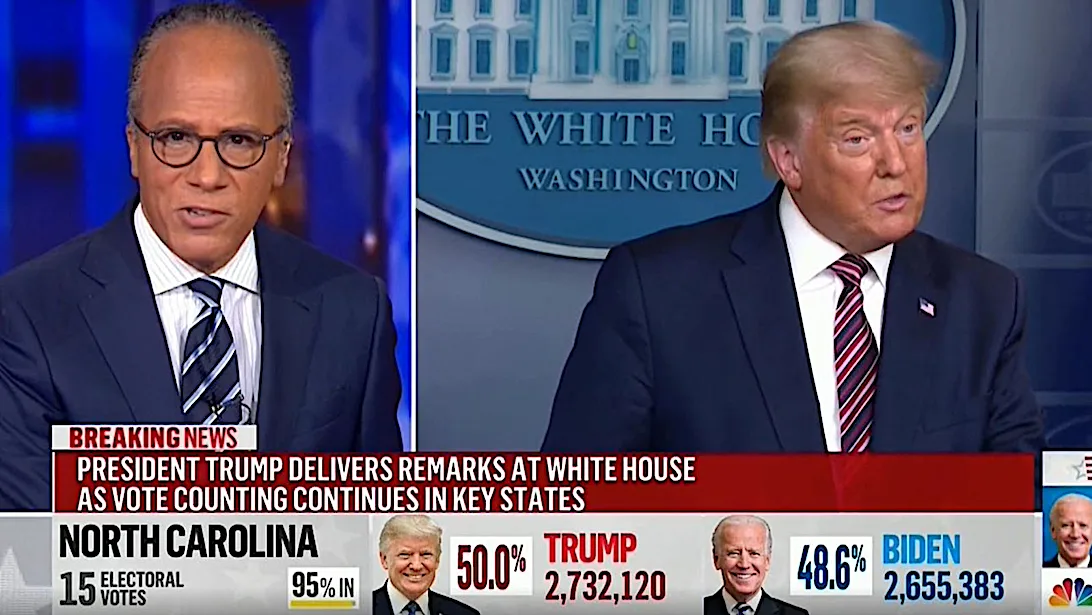
(IMAGE: SCREENSHOT)
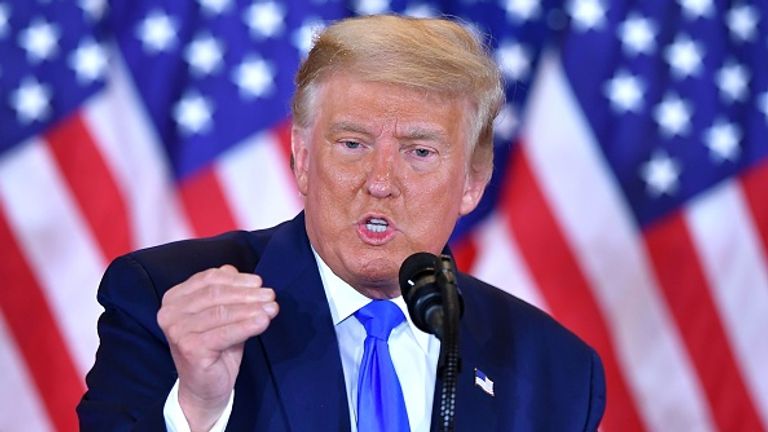
In a speech in the initial early hours of counting, Donald Trump declared himself the winner of the US election and has since made unsubstantiated claims of election rigging and voter fraud.
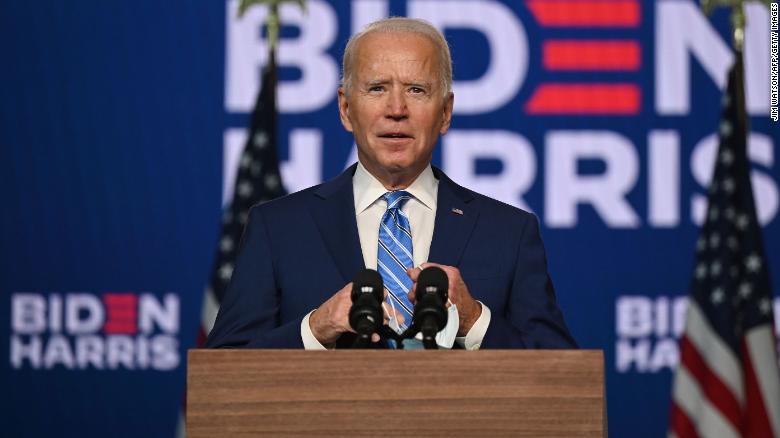
His challenger Joe Biden, who appears to be on the verge of victory, has appealed for calm and patience, saying “each ballot must be counted”.
And now it seems like patience will be the key.
Here’s why there’s been a delay:
Postal votes are largely to blame. As is the US system of allowing states to make all their own (and often differing) rules on anything, but in this case specifically, also on vote counting.
This means that each state sets a different timeline and deadline for when they should be tallied.
Rules in some states don’t allow election workers to begin the labour-intensive work of processing postal (or “mail-in ballots” as they are known in the US) until election day itself.
The deadline for postal votes in North Carolina is 10 November, Alaska is 12 November, and in Washington state, it stretches to 23 November.
Washington and Alaska are relatively unimportant for the final result in the presidential race, in that Washington is strongly Democrat and Alaska is fairly solidly Republican, but it nevertheless means a full vote count will not be available for many days to come.
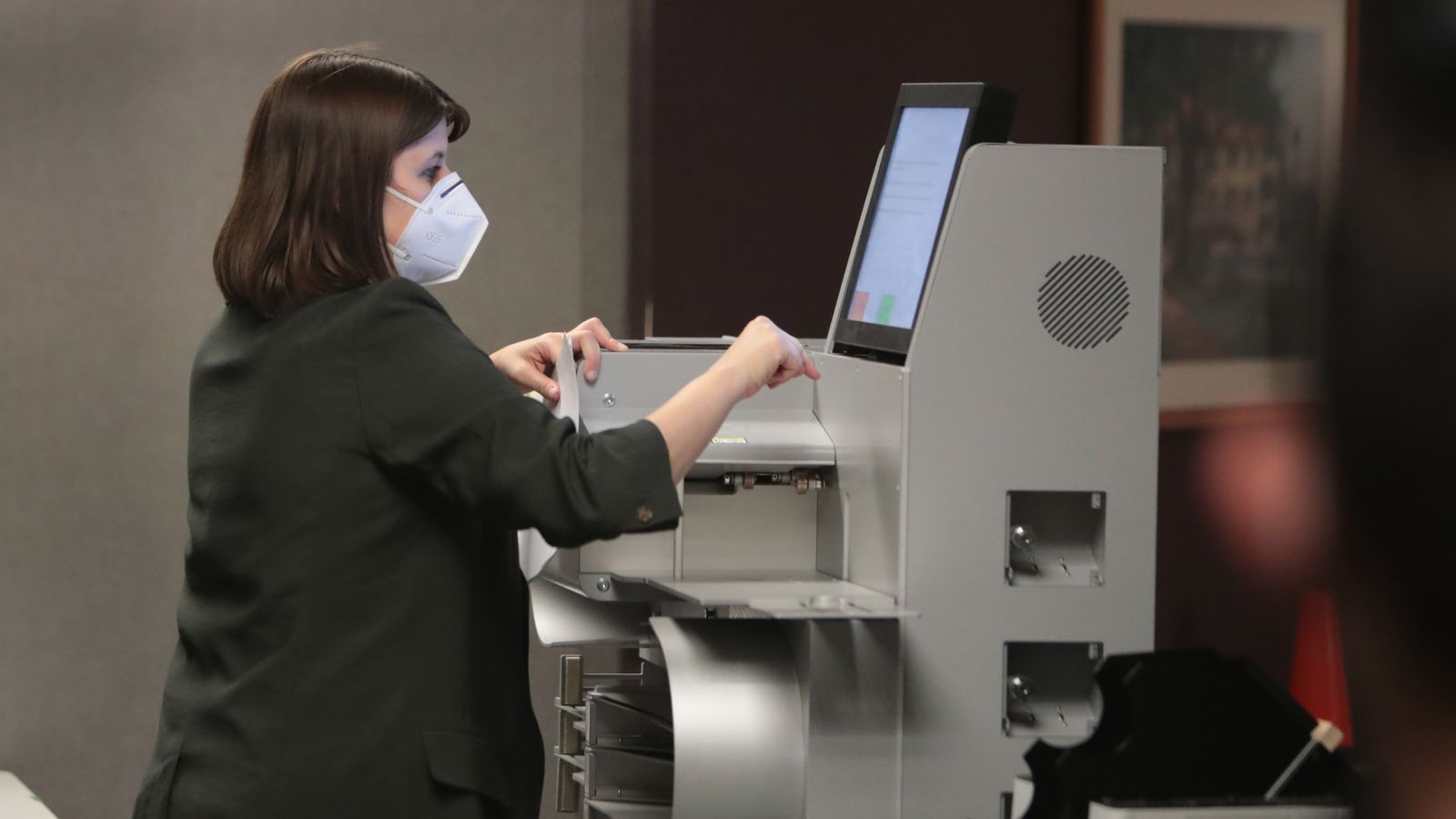
All eyes are on the vote counters (IMAGE: SKY NEWS)
Postal votes typically take longer to count then those made at a polling station, as they have to go through a longer process of steps to ensure they are not fraudulent.
Of course, this year, there have been record numbers of them – more than 99 million – due to the coronavirus pandemic. And because of that, dozens of states have modified their rules for mail-in voting – some of those changes being more substantial than others.
California, Nevada, New Jersey and Vermont, along with Washington DC for instance, sent mail-in ballots to all voters, joining the handful of states that already conduct all-mail elections.
There’s also been a big expansion in who can vote “absentee”. Many states, including New Hampshire and New York, have suspended the need for an excuse to obtain an absentee ballot, or said fear of contracting COVID-19 while voting is a valid excuse.
Other states have altered deadlines and/or loosened rules for submitting an absentee ballot. Some states – often as the result of litigation – have said mail-in ballots only need to be postmarked by election day, rather than received by then. And in Virginia, for instance, an absentee ballot won’t need a witness signature.
In short, the voting rules vary widely, making announcing an overall winner a difficult – and slow – process.
Of the final states left to declare:
There may be a delay in Arizona making a call (IMAGE: SKY NEWS)
Arizona
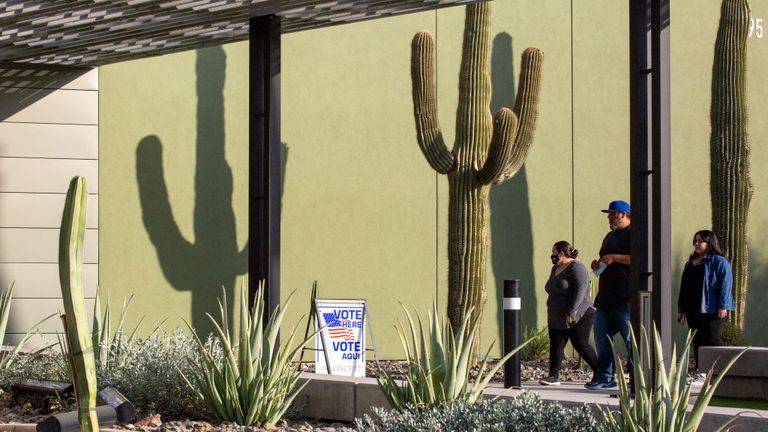
State law in Arizona allows election officials to count mail votes up to two weeks before election day. Those tallies can be released starting around 10pm on election night.
However, absentee ballots sent right before the election (as long as they are postmarked before 3 November), may not be tallied until Friday, so the state could remain undecided into next week.
North Carolina
The North Carolina State Board of Elections estimated 80% of votes would be cast early or by mail and were largely counted after their polls closed at 7.30pm on the night. But its outside deadline for these kinds of votes is 12 November, meaning a full count total will not be available for some days yet.
So long as the mail-in votes were postmarked by election day, they will be counted – a policy recently upheld by the US Supreme Court. So, as in other states with generous mail ballot deadlines, those final ballots could mean the full result is unclear for days.
Nevada
This state has a deadline of 10 November for mail-in ballots.
Alaska
Alaska is one of only two states that begin counting absentee ballots after election day. New York is the other state, and it begins counting absentees three days after the election. Alaska’s deadline for finishing is 13 November.
Pennsylvania
Soon after President Donald Trump took the key swing state of Florida, the focus shifted to the northeastern US and the battleground state of Pennsylvania. Back in 2016, Trump’s win here is what ultimately led to his victory over Hillary Clinton.
Of the three, it is Pennsylvania – and its 20 electoral college votes – that has always been expected to be close, with thin margins and the very real prospect of recounts and legal challenges.
Its deadline for postal ballots is Friday 6 November.
Pennsylvania election officials can accept mail ballots that arrive up to three days after the election, as long as they were postmarked by 3 November.
Many counties began processing ballots as soon as they were allowed – at 7am on polling day – but a handful said they would not begin dealing with absentee ballots until the next morning at the earliest.
If the 2020 election comes down to Pennsylvania, and the margin remains tight, it is possible the election hangs in the balance for several days.
Donald Trump’s campaign on Wednesday declared victory in the state, and also filed a suit in the Supreme Court asking for the remaining ballots not to be counted.
The campaign said that it was suing to temporarily stop the vote count in Pennsylvania, citing a lack of “transparency” in the count process.
What is Trump’s issue with postal voting?
The president’s latest claims over the postal vote system have not be substantiated
The sitting president has made no secret of the fact that he is against people voting by post and indeed, most Republicans listened to his argument and voted in person.
He described the mail-in system as being subject to “tremendous fraud”.
His stance was in some way boosted by a warning from the US Postal Service (USPS) back in the summer that millions of mail-in votes may not arrive in time to be counted due to the record numbers of applications.
Critics even went so far as to blame the new USPS head – a loyal supporter of President Donald Trump – for a slowdown in deliveries.
Trump feared postal votes would hurt his campaign since it is largely supported by Democrat voters and he took the drastic step of refusing to sign off on $25bn (£19bn) in emergency funding for the USPS or $3.5bn for election security, claiming his move was due to the cost alone.
Trump has also repeatedly condemned mail-in voting as an opportunity for fraud and election interference.
But numerous national and state-level studies have shown that although there have been isolated cases, electoral fraud is very rare.
Social media platform TikTok has emerged as an unexpected source of misinformation about the US election, with numerous inaccurate or misleading posts circulating as tech companies battle to contain falsehoods from Donald Trump and others.
“TikTok has in the past been a breeding ground for false reports that spread peer to peer,” said Angelo Carusone, the president of Media Matters and an expert on rightwing extremism and misinformation.
The report identified 11 examples of election misinformation on Wednesday that racked up more than 200,000 combined views before TikTok removed them. On Thursday, it found that videos pushing a Qanon-related conspiracy theory about ballots went viral, amassing more than 200,000 views in just a few hours before TikTok removed them for violating its misinformation policy.
The social media platform TikTok ‘has in the past been a breeding ground for false reports’, said the president of Media Matters. Image: Reuters
Misinformation in these videos included false narratives that claimed ballots being counted for Joe Biden were fraudulent, and that poll workers were handing out markers to Trump voters so their votes would go uncounted.
Some of the content originated from young Republican influencers on TikTok: two pro-Trump pages called Republican Hype House and The Republican Boys echoed Trump’s rhetoric in claiming the election was being stolen. TikTok cracked down on the accounts, flagging some of the videos and leading one of the accounts to post an apology on Wednesday, promising to post less frequently to ensure it does not get deplatformed by TikTok.
“We’re working diligently to protect the integrity of our platform as the election cycle continues,” TikTok said in a statement. “We’re removing election misinformation as it’s identified – proactively through automated technology and human investigations, and reactively via reports from our users and partners.”
The company removed almost all 15 videos mentioned in both reports and has been cracking down on other sources of misinformation. It did not remove one video, but rather reduced its reach and added a banner linking to correct information.
Despite these viral examples, the video-sharing platform is the newest of the major social media firms and is doing relatively well given its inexperience, Carusone said. This may be in part because, compared with Facebook and Twitter, TikTok was initially seen less as a forum for political news and discussion and more as a space to share funny videos.
Carusone continued: “I think it is worth focusing on these individual examples, even if they are not representative of the entire platform as a whole, because what they do is identify gaps in the preventative measures that the platform has.”
Meanwhile, Twitter has flagged or removed content with misinformation referencing election results before they are released – including tweets from Trump. It has also reduced the reach of flagged tweets and eliminated algorithmic recommendations like trending topics to minimize the spread of misinformation. Facebook, similarly, is flagging posts in which the president or others call the election before reputable sources have. On Thursday Facebook shut down a group being used to organize in support of stopping the count of votes in key states.
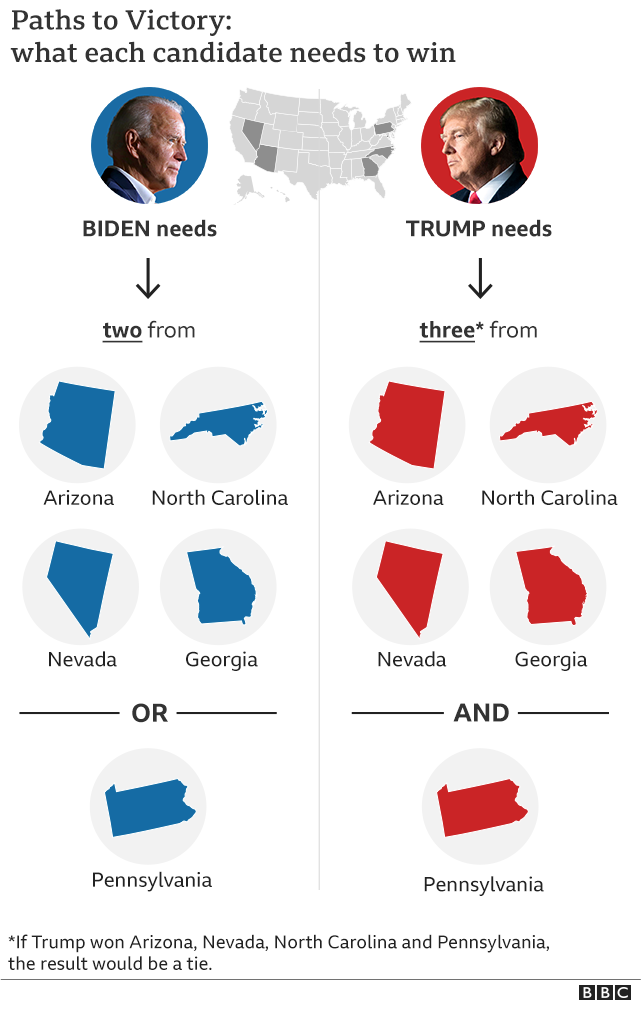
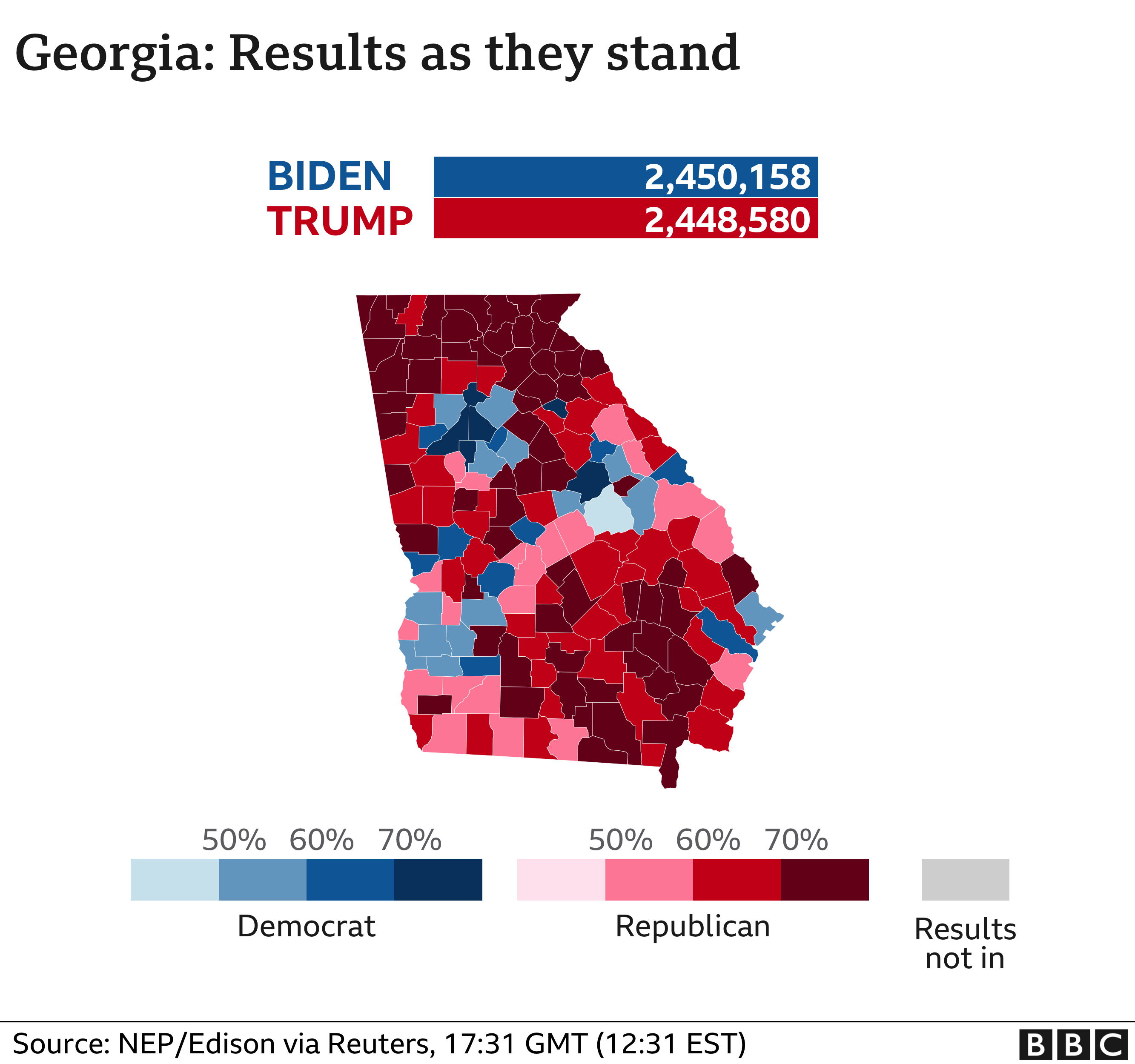
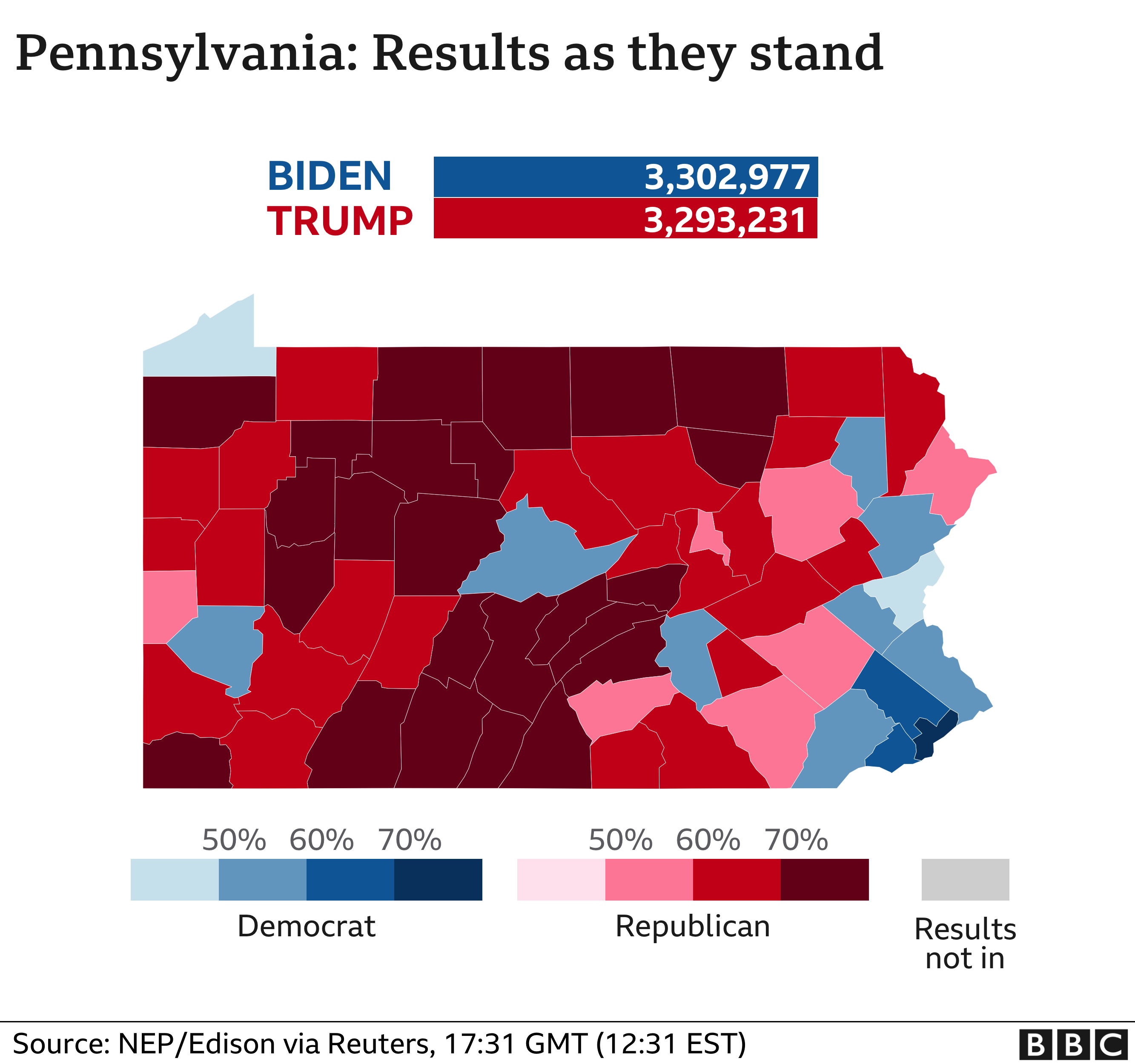
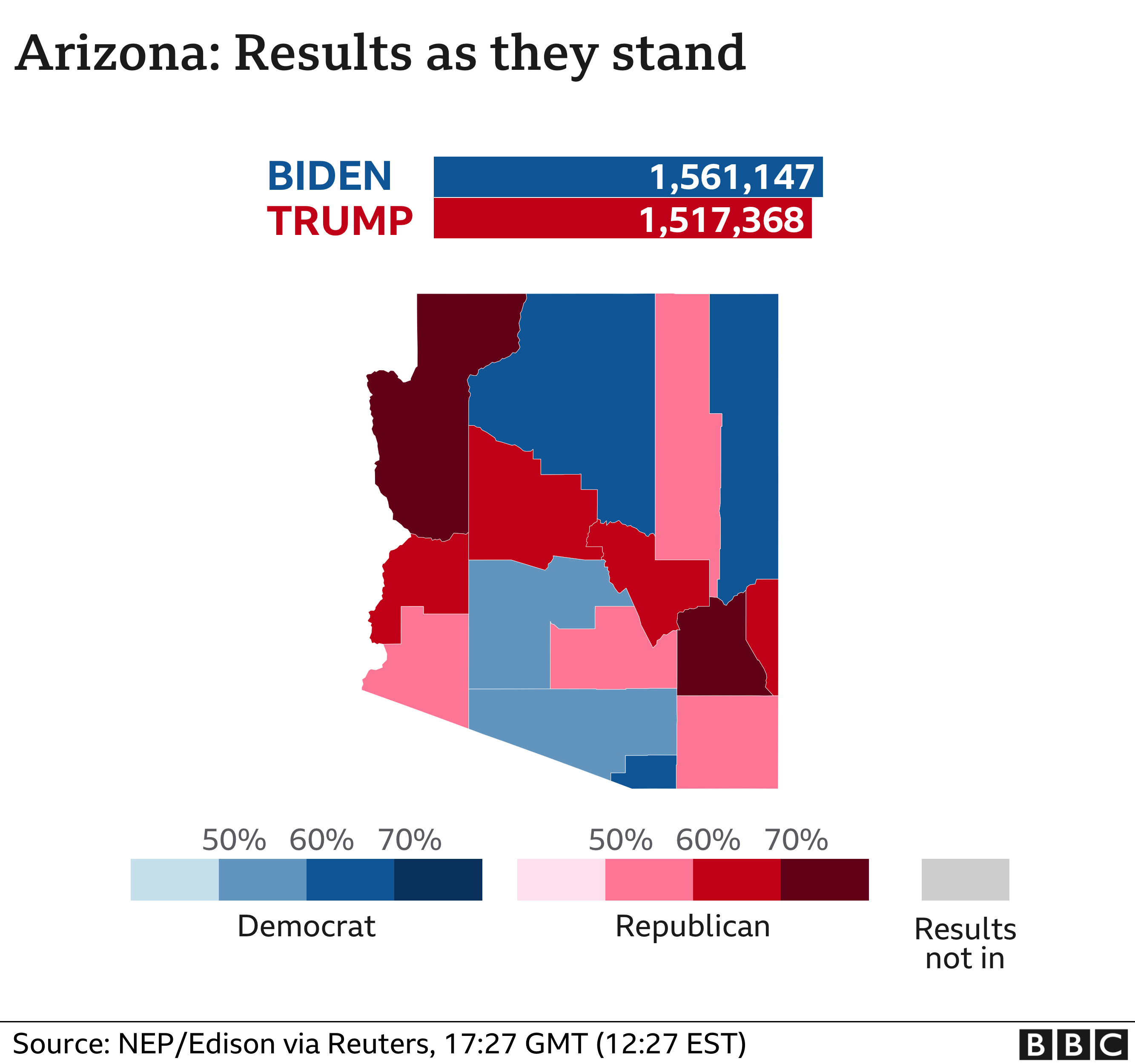
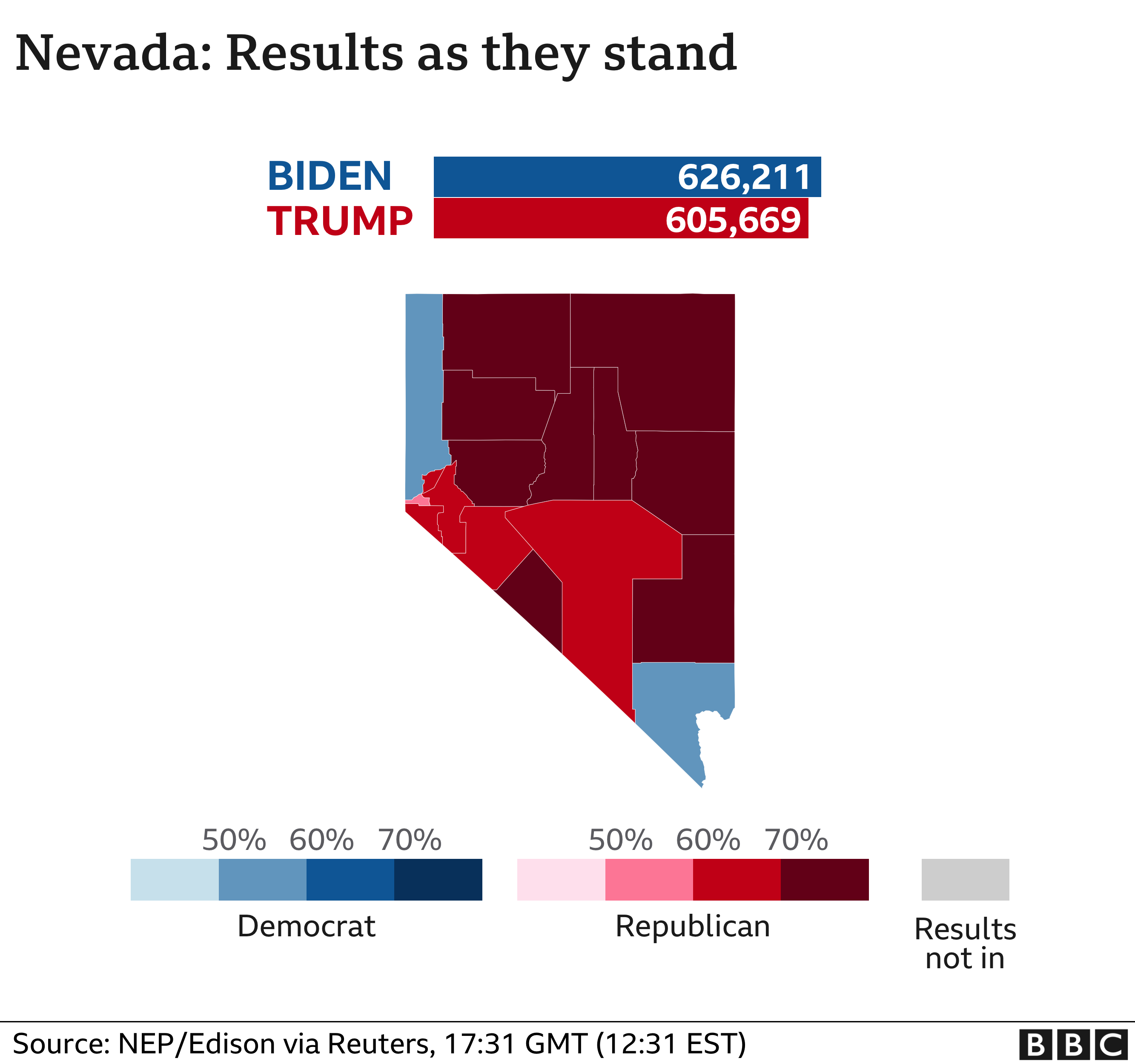
The race for the White House is coming down to who wins the few remaining battleground states – Georgia, Pennsylvania, Nevada and Arizona.
A win in just Pennsylvania or two of the other four remaining states would be enough to confirm Mr Biden as president-elect, barring any legal challenge.
Mr Trump, meanwhile, needs to win Pennsylvania and three of the remaining four states.
Here’s the state of play in the states at play.
GEORGIA – 16 electoral votes
Where things stand: The BBC’s results system is showing a Biden lead in Georgia of just over 1,500.
How many votes are still to be counted: Georgia Secretary of State Brad Raffensberger said on Friday that 4,169 votes remain to be counted, and that some 8,000 military absentee ballots are still in the mail and will only be counted if they arrive by the end of the day.
Where are these votes? The votes being counted are postal ballots mostly from Atlanta and Savannah, which have skewed heavily toward Biden.
When will we learn more? Raffensberger announced on Friday that the state’s presidential contest will go to a recount, so we could be waiting a while.
PENNSYLVANIA – 20 electoral votes
Where things stand: Biden is now leading Trump by 9,027 votes, according to the BBC’s election system.
How many votes are still be counted: Just over 163,000 votes remain.
Where are these votes? In counties won by Hillary Clinton in 2016, so mostly Democratic votes.
When will we learn more? State officials said they hoped to count the “overwhelming majority” of the outstanding votes by the end of Thursday. That raises the possibility of a projection on Friday morning. Let’s see.
ARIZONA – 11 electoral votes
Where things stand: Biden still has a lead of about 43,000 – but Trump has been gaining steadily throughout the day.
How many votes are still be counted: As of Thursday night, there were approximately 300,000 ballots outstanding.
Where are these votes? They’re from all over this diverse state, but most are in the area around Phoenix.
When will we learn more? We’re expecting another batch of results at 09:00 local time on Friday (16:00GMT) – we don’t know how many or if they’ll prove decisive.
NEVADA – 6 electoral votes
Where things stand: Biden is holding his lead over Trump by around 20,000 votes, according to the latest results.
How many votes are still to be counted: Officials say there are about 190,000 ballots remaining.
Where are these votes? About 90% of the votes are from Clark County which includes Las Vegas, and the majority of them are postal ballots.
When will we know more? An additional 51,000 ballots will be reported on Friday, according to Joe Gloria, an official in Clark County. A clearer result will likely come by the weekend.
Former Vice President Joe Biden has taken the lead in his birth state of Pennsylvania as the number of outstanding ballots has dwindled, putting the Democrat within striking distance of the 270 electoral votes that he needs to win the White House.
For former Vice President Biden, eclipsing Trump in the Keystone State was a symbolic moment in the course of a political career that has spanned nearly five decades.
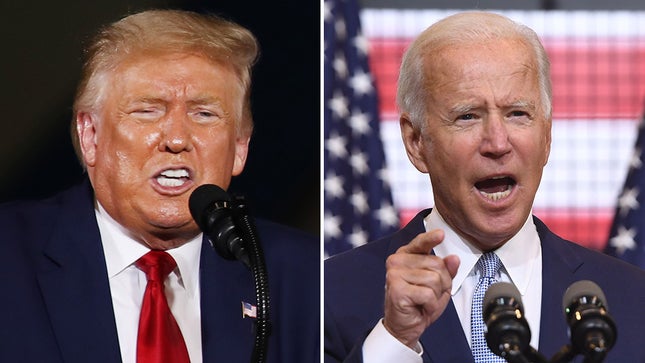
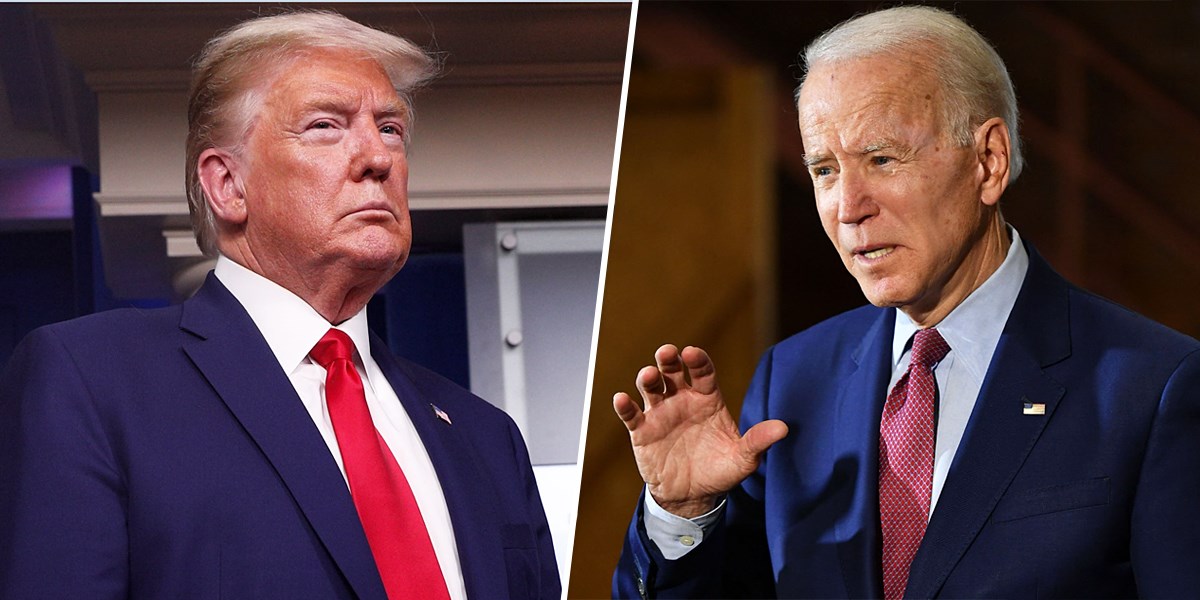
President Donald Trump and Joe Biden. (Image: AFP – Getty Images)
With the latest batch of tabulated vote counts released Friday morning, Biden now has a lead of nearly 7,000 votes in the state.
Tight races are also going into overtime in two other states that could influence the destiny of the race, Nevada and Arizona, where Biden’s lead tightened late Friday morning to just more than 43,000 votes
Biden so far has 253 electoral votes and the President has 213.
During the long and hard-fought primary Democratic primary, Biden repeatedly made the case that he alone could sway the blue-collar voters who abandoned his party to support Donald Trump in 2016 and could rebuild the Democrats’ “blue wall” in the Midwest that Trump had demolished.
Biden succeeded in that goal by notching wins in Michigan and Wisconsin, according to CNN projections, and Pennsylvania would be the capstone of that long-held dream for the former vice president.
For several days now, Biden advisers have insisted that they are confident the Democratic nominee can hold Pennsylvania and the momentum has moved unrelentingly in Biden’s favor.
As officials have counted the hundreds of thousands of vote-by-mail ballots, Biden dramatically narrowed Trump’s lead, infuriating the President and his allies, who know the President’s path to reelection is over if he cannot hold the commonwealth. If Pennsylvania serves as the key in Biden’s path to the White House, it would be a fitting end to his longstanding effort to cultivate his image as “Middle Class Joe” who understands and empathises with the frustrations of the working-class voters of the industrial Midwest — voters Trump courted by calling them the “forgotten men and women” of America.
To underscore that point on the morning of Election Day, Biden made a final trip to his childhood home where his Scranton supporters surrounded him on the street to wish him good luck. On one of the living room walls in his boyhood home, he wrote: “From this House to the White House with the Grace of God,” signing his name and the date, “11.3.2020.” But Pennsylvania was not the only state that was tightening Friday morning in this cliffhanger election.
The momentum of the race has shifted in Biden’s favor — putting him on the doorstep of the critical threshold of 270 electoral votes needed to become president — as he has racked up huge margins among mail-in ballots favored by Democratic voters.
Biden jumped ahead of Trump in Georgia around 4:30 a.m. on Friday and leads by just more than 1,000 votes. The former vice president’s surprising strength in Georgia stemmed from huge turnout from Black voters in Fulton County and other suburbs around Atlanta, fatigue with Trump in Georgia’s fast-growing suburbs — which have become increasingly young and diverse in recent years — and assiduous work over more than a decade to boost Democratic registration in the state.
No Democratic presidential nominee has won the state since Bill Clinton in 1992. Clinton narrowly defeated former President George H.W. Bush in that state in part because he and Bush were in a three-way race that included Ross Perot, an independent candidate for the presidency.
Even as vote totals now show him trailing Biden in key battleground states, Trump has not prepared a concession speech and in conversations with allies in recent days, he has said he has no intention of conceding the election, people familiar with the matter said. Trump’s campaign made clear in a statement Friday that it will contest the election, calling the race “far from final.”
In response to reports Trump has no plans to concede, Biden’s campaign said, “The American people will decide this election.”
“And the United States government is perfectly capable of escorting trespassers out of the White House,” campaign spokesman Andrew Bates said in a statement.
Pennsylvania, the state that could take Biden over the 270-vote threshold, could complete most of its outstanding counts on Friday, officials there said.
Tens of thousands of votes remain to be counted. The remaining pool of Philadelphia votes to be counted is about 25,000, according to a city official and an official familiar with the counting. These will take longer to count because they are provisional ballots as well as ones that require review because of issues like dates or signatures. The sources said city election officials are starting this batch from scratch. “It’s going to be a while,” one of the sources said.
Trump cannot find a route to 270 electoral votes without Georgia and Pennsylvania, so his chances of securing reelection will hinge on developments in the two states in the coming hours.
But on Thursday night, Trump effectively sent a signal that he has no intention of leaving power without a fight if he ends up losing the election.
Trump made ludicrous claims that his leads on election night shrunk because Democratic officials keep finding ballots, when in fact the counts have narrowed because election officials in many states counted the vote-by-mail ballots, which favored Democrats, after the Election Day votes, which tended to favor Republicans.
Biden urges calm
Even as the votes are still being counted in Pennsylvania, Biden’s advisers have mounted an aggressive behind-the-scenes push to get his supporters — and, even more importantly, Republicans — to help validate the sanctity of the election.
The Biden campaign took note of Trump’s dire tone in the White House Thursday night and began a plan that is underway Friday to get Biden’s old allies in the Senate — and others from a lifetime in public life — to speak to the legitimacy of the election.
Biden emerged in Wilmington, Delaware, for a short speech Thursday meant to project optimism, urge patience in the vote counting and to apparently create a picture of a presidency in waiting.
“In America, the vote is sacred. It is how the people of this nation express their will,” he said, calling for calm and patience as the vote counting process unfolds.
The President’s team, in contrast, had earlier bullishly insisted that the President would win Pennsylvania with some room to spare. “Donald Trump is alive and well,” Trump’s campaign manager Bill Stepien said.
The balance of power in the US Senate may not be decided until January, as Georgia may have to hold run-off elections for both its seats.
No candidate in either race has polled 50%, as required by state election law.
The run-off elections would take place on 5 January, two days after the new Senate is due to convene.
The Republicans currently have a 53 to 47 majority in the Senate and appear on course to retain control, with a loss so far of one seat overall.
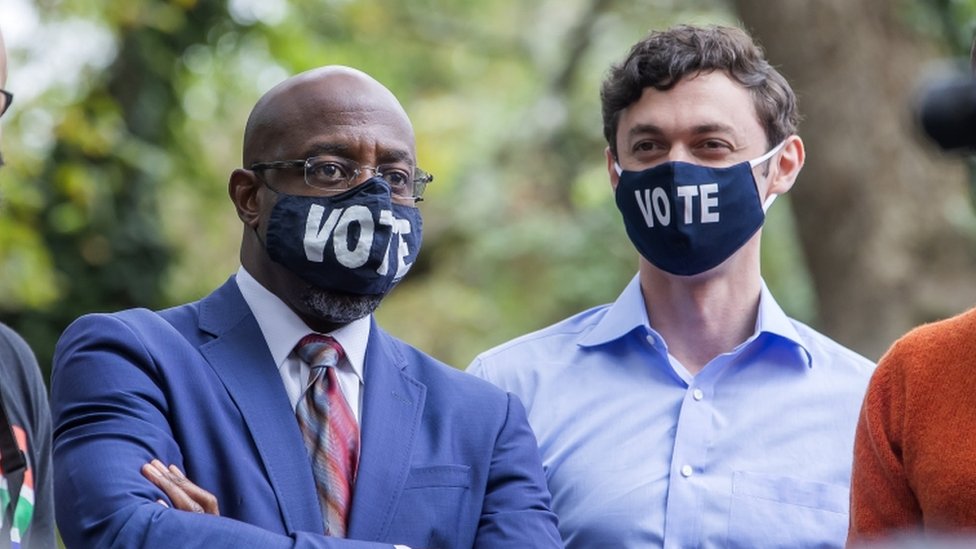
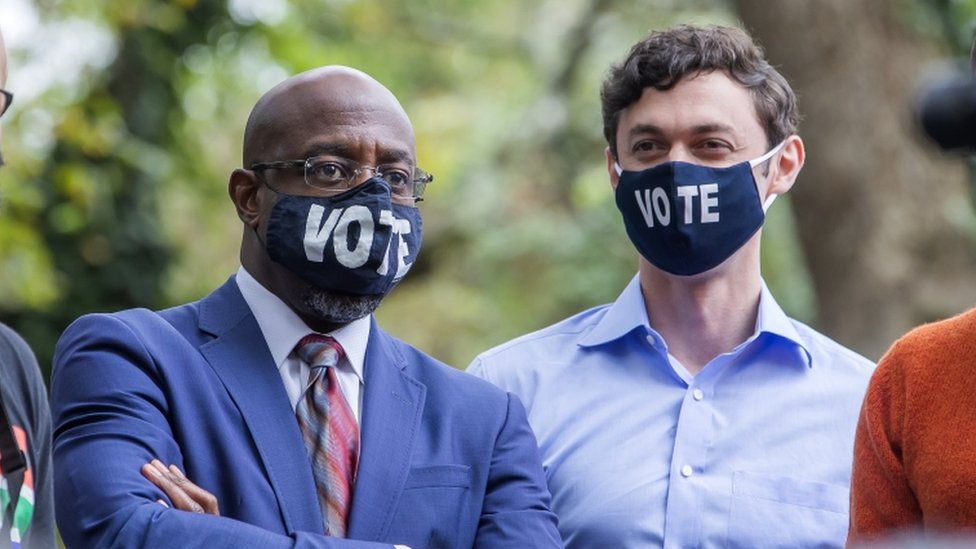
Raphael Warnock (left) holds a clear lead ahead of his run-off vote, but Jon Ossoff (right) is neck-and-neck with his Republican challenger (IMAGE: EPA)
The Democrats had high hopes of gaining the four seats they needed to take control, but many Republican incumbents held their seats.
If however the Democrats can gain both seats in Georgia, a traditionally Republican state, this would lead to a 50-50 tie in the Senate.
Senators Kelly Loeffler and David Perdue could both lose their seats (IMAGE: REUTERS)
In one of Georgia’s Senate races, incumbent Republican David Perdue is falling just short of 50% of the vote in his battle against Democrat Jon Ossoff and Shane Hazel from the Libertarian Party, with 98% of the ballots counted.
“If overtime is required when all of the votes have been counted, we’re ready, and we will win,” said Mr Perdue campaign manager Ben Fry.
But the Ossoff campaign predicted that “when a runoff is called and held in January, Georgians are going to send Jon to the Senate”. He currently trails Mr Perdue by 2 percentage points.
In Georgia’s other Senate race, Democrat Raphael Warnock won 32.8% and will go into a run-off against Republican Senator Kelly Loeffler, who trailed him with 26%.
Ms Loeffler was appointed to the Senate last year to fill a seat left vacant when her predecessor retired.
Of the 35 Senate seats being contested, 23 were Republican-held and 12 were Democrat.
The Democrats had hoped to gain several seats, but one of only two wins came in Colorado, where former Governor John Hickenlooper defeated Republican incumbent Cory Gardner.
They also won a seat in Arizona, where former astronaut Mark Kelly defeated Republican incumbent and former fighter pilot Martha McSally. But this gain was cancelled out when Alabama Senator Doug Jones lost to Republican candidate Tommy Tuberville.
In Maine, the moderate Republican incumbent Susan Collins staved off a fierce challenge from Democrat Sara Gideon.
Democrats have not had control of the Senate for six years.
Why do different news sites have different tallies?
If you are seeing different tallies at the top of the live coverage from various news sites, you might well be confused.
The BBC is projecting that Joe Biden will take Wisconsin, in line with its American sister network CBS.
With 99% of the votes counted, Biden currently has a lead there of just over 20,000 on Donald Trump. The tally above now includes the state’s 10 electoral college votes.
PICTURE: GETTY IMAGES
Our projection that Joe Biden is the presumptive winner in Wisconsin reflects the situation now. If, as the Trump campaign has requested, a recount takes place, we will report that and the result – and if necessary, we’ll change our projections accordingly.
For the 2020 election, the BBC is using data supplied via Reuters, from polling firm Edison Research, which does the field work for the exit polls and works with US television networks in the National Election Pool.
Edison Research has not projected a result for Wisconsin because the margin between Biden and Trump is less than one percentage point, meaning a candidate can request a recount.
You may have noticed that some other news sites are also projecting a win in Arizona for Biden, giving him an extra 11 electoral college votes. The BBC, again in line with CBS, considers the state too early to project.
With 87% of the vote in Arizona counted, Biden currently has a lead of about 68,000 over Trump.
The Chiefs and traditional leaders of Ave Dakpa in the Akatsi North District of the Volta Region Monday lauded President Akufo-Addo for the numerous developmental projects and programmes initiated by his government in the area.
They mentioned the Planting for Food and Jobs, Planting for Export and Rural Development, NABCO, Free Water, Free Electricity, One District One Ambulance, and Free Senior High School and many social policies interventions to enhance the livelihood of the people.
The Paramount Chief of Ave Dakpa, Torgbui Nyamekor Glakpe V, conveyed the people’s appreciation when he led a delegation of chiefs and elders to pay a courtesy call on the President at the Jubilee House in Accra.
The Paramount Chief said the programmes and policies of the current administration were impacting the lives of Ghanaians and the people of Akatsi North.
He expressed gratitude to the government for elevating all six Paramount Chiefs of the Ave Traditional Area to the Volta Regional House of Chiefs.
“As for the coming elections, your good works will speak for you come December 7.We will pray for you and trust that God will hear our prayers for you.
“Communities like Avevoe, Hadave and Nuaxorve have witnessed the construction of a three-Unit Pavilion Classroom block each for the first time in the history of these communities. These communities have schools but no classroom blocks.
“With the District Assembly Common Fund, your government made it possible for them to have classroom blocks which are aimed at boosting education in these communities. Other communities that benefited from this 3-Unit Pavilion Classroom projects include; Seva, Ave Havi, Atanve, Amule, Kpegbadza, and Adzigo, ” he said.
He said the GETFUND has also completed projects that were started by the previous government, including 6-uint classroom blocks at Atiglime, Agormor and Ave Senior High School.
GETFUND has provided funding for 6 unit classroom blocks at our Islamic School, Ave Afiadenyigba and others at Ave Dzadzepe and Ave Seva. KG blocks at various places including Ave Kpeduhoe, Ave Posmonu, and Lome-Ghana, he added.
In the area of health, he said the government has, through innovative financing, constructed a CHPS Compound in Kpeduhoe which was completed awaiting commissioning, CHPS Compound in Agormor which was also at the completion stage with Nurses Quarters and CHPS Compound in Zemu which was at the lentil level.
“Your government is actually putting up a Theatre at Ave Dakpa Health Centre which has also reached roofing level. Mr. President, your government through the DCE is actually putting up an ultra-modern market facility which is fast picking shape.
“Currently, an abattoir has been built, 20 lockable stores completed, a KG block almost completed and a borehole drilled all in the new Ave Dakpa Central Market. There are communities in the Akatsi North District that witnessed mechanized boreholes as source of drinking water for the first time under your regime,” he said.
The Chief said Lome-Ghana, Atsata Bame, Ashiagborvi, Zemu, Kortey and Agormor could now boast of improved access to potable water
President Akufo-Addo, in a short remark, thanked them for the strong words of commendation and expressed the government’s commitment to improve the state of roads in their communities.
He also pledged to procure a bus for the Ave Senior High School and thanked the traditional leaders for the invitation to enstool him as Special Development Chief community.
He pledged to honour the request before the December polls.
Professor Kwadwo Adinkra-Appiah, the Vice-Chancellor of the Sunyani Technical University, has been elected the Chairman of the Vice-Chancellors of Technical Universities-Ghana (VCTU-G).
He took over from Rev. Prof John Frank Eshun, the Vice-Chancellor of Takoradi Technical University, and will serve for one year.
The VCTU-G, made up of heads of public technical universities, is a forum that deliberates on issues regarding promotion of Technical and Vocational Education and Training (TVET).
At its last meeting in Accra, the VCTU-G overwhelmingly endorsed Prof Adinkra-Appiah, a statement issued by the Sunyani Technical University (STU), and copied to the Ghana News Agency, said.
Prof Adinkra-Appiah applauded his predecessor for the good job done and pledged to continue from where he ended and commended the Government for the efforts made in transforming TVET.
Born at Atuna in the Jama South District of the Bono Region, Prof Adinkra-Appiah has served in various management positions at the Sunyani Technical University, namely; Acting Head of Building Technology Department (2007-2009), Acting Dean of School of Engineering (2009-2012), Vice-Rector (2013-2016), Rector (2016) and Interim Vice-Chancellor (2016-2019).
He is a graduate of the Kwame Nkrumah University of Science and Technology (KNUST) with B.Sc. Engineering and MPhil Civil Engineering obtained in 1998 and 2006 respectively.
He obtained a PhD in Civil Engineering in Structural Modelling at the RISA Technologies in California, USA, in 2006 and has authored several research publications.
He won the Ghana Institution of Engineering Excellence Award in 2016 as the ‘Most Innovative Researcher of the Year’ and his research works has led to the introduction of an innovative building block in the nation’s construction industry, dubbed: “Salamorete Building Block’ for sustainable construction.






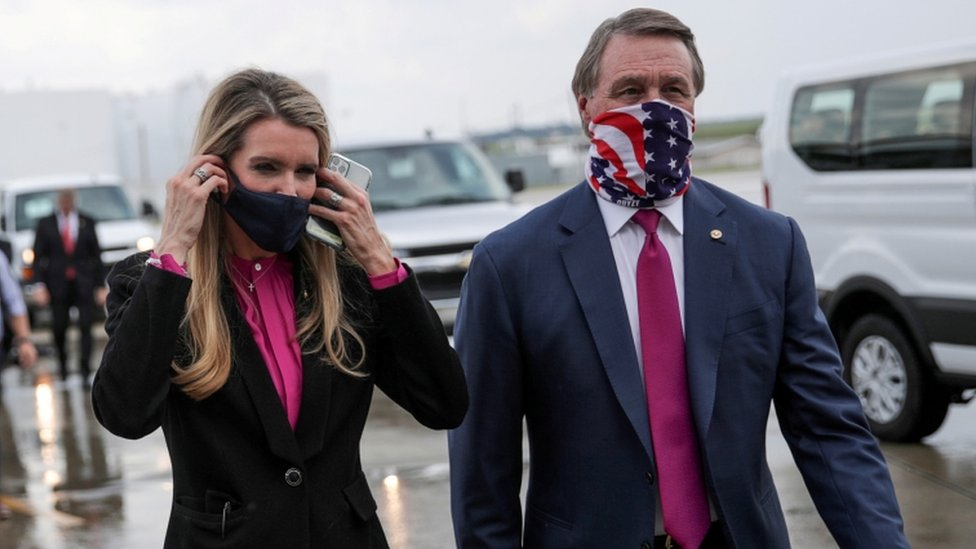 Senators Kelly Loeffler and David Perdue could both lose their seats (I