Home Blog Page 124

Ghana Election 2024: NPP must fall on December 7—Valerie Sawyerr.

0

A former senior policy advisor to former President John Mahama, Dr. Valerie Sawyerr, has urged the Electoral Commission (EC) and the security agencies to ensure a free, fair and transparent election on December 7 to consolidate the country’s democratic gains. 

She accused the ruling New Patriotic Party (NPP) of perpetrating violence, corruption and economic mismanagement during its eight-year tenure.

In an article for publication in the Daily Graphic, Dr Sawyerr said Vice-President, Dr. Mahamudu Bawumia, had been “sloppy, incompetent, and lacklustre” during the NPP’s eight-year tenure and did not deserve the support of Ghanaians for another term in the upcoming election.

She invoked the iconic Bob Marley song “Small Axe” to symbolise the opposition National Democratic Congress’ (NDC) determination to challenge the ruling party.

“If you are the big tree, we are the small axe, sharpened to cut you down,” she quoted.
 

Vigilance

The former Deputy Chief of Staff under the John Atta Mills administration urged members of the NDC to remain focused and vigilant.

“We must be vigilant! We must man the polls with distinct alertness and quickened minds. We must not allow any man, woman or hermaphrodite to apply any means whatsoever to manipulate the system,” she cautioned.

She cited the example of the unwavering determination of Radio Gold, a pro-opposition radio station, in the 2008 elections as it acted as a channel of accurate and timely information to direct the NDC to victory. She applauded the strength that the NDC displayed in the fight for victory. 

Dr Sawyerr rallied NDC members, supporters and sympathisers to rise up and finish the fight—to cut down the “big tree” (NPP) even though the NDC might seem to be the “small axe.”.

Dr Sawyerr urged all Ghanaians to remain vigilant and to demand a free, fair and transparent election.

“Let us refuse to sink into dungeons where we devour one another. Let us reject a future of civil war, chopping off arms and legs, eradication of infrastructure and further destruction of an already destroyed economy,” she said.

Impartiality

Dr. Sawyerr called on security agencies to remain impartial and professional and to avoid any actions that could be perceived as biased or partisan. 

“We do not want soldiers at the polling stations! No soldiers at polling stations! No soldiers at polling stations!” she emphasised.

Dr. Sawyerr challenged the EC to conduct the election in a free and fair manner and refuse to be cowered into submission by a “slave master.”.

“There is an enormous weight on your shoulders and you must execute to perfection so that when you are no longer at the post, you would have left behind a slither of a legacy”, she said.

Mahama

Dr Sawyerr expressed utmost confidence in the NDC’s Presidential Candidate, John Dramani Mahama, saying he was a man of truth and a leader who would bring development to all parts of the country.

“He is a man who extends developmental projects to all corners of the country regardless of religious, ethnic or political affiliation,” she said.
Ashanti Region Boasts 58 Factories Under 1D1F Initiative.

0

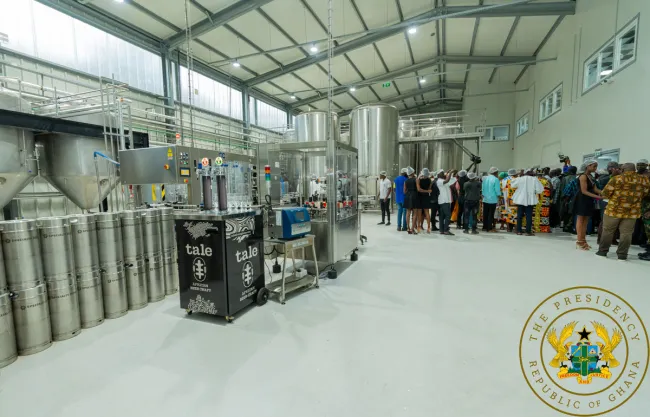
The Ashanti Region has emerged as a hub for industrialization in Ghana, with a total of 58 factories operational or under construction under the One District One Factory (1D1F) initiative.

This impressive feat is a testament to the region’s potential for economic growth and development.

According to a comprehensive list of factories in the Ashanti Region, 31 factories are already in operation, while 27 are under construction.

These factories span various sectors, including food processing, manufacturing, pharmaceuticals, and agriculture.

The 1D1F initiative, launched by the government in 2017, aims to establish at least one factory in each of Ghana’s 260 districts.

The program is designed to promote industrialization, create jobs, and stimulate economic growth at the local level.

In the Ashanti Region, the 1D1F initiative has made significant strides, with factories springing up in various districts. For instance, the Ejisu Municipal District boasts 11 factories, including Premium Foods Limited, Vester Oil Processing Company Limited, and Josma Agro Limited.

Other districts with a significant number of factories include the Asokwa Municipal District, which has six factories, and the Atwima Kwanwoma District, which has five factories.

The operational factories in the Ashanti Region are already making a significant impact on the local economy.

For example, the Kasapreko Company Limited, which produces bottled water and non-alcoholic beverages, has created jobs for many residents in the Tanoso area of the Kwadaso Municipal District.

Similarly, Bodukwan Farms Limited, which cultivates and processes mango into juice and other products, has become a major employer in the Sabin Akrofrom area of the Atwima Kwanwoma District.

The 1D1F initiative has also attracted investments from both local and foreign companies.

For instance, the Fu Cai Company Limited, a Chinese-owned company, has established a steel factory in the Daa Bekwai Municipality.

As the Ashanti Region continues to experience rapid industrialization, the government has been urged to provide the necessary support to ensure the sustainability of these factories.

This includes providing access to credit facilities, training programs for workers, and infrastructure development to facilitate the transportation of goods and services.

Don’t rush to post on social media – Ace Ankomah advises media to verify content first.

0

Mr. Ace Anan Ankomah, a private legal practitioner, has cautioned media practitioners and the public about the dangers of rushing to post unverified information on social media, especially during election periods.

Addressing the legal risk associated with online communication, Mr. Ankomah underscored the critical importance of verifying content before sharing it online, as that had potential legal ramifications.

He was speaking at a Media Executive Breakfast organized by the Africa Media Bureau (AMB) on the theme “Ethical Consideration and Risks in Programming for Social Media: Responsible Election Reporting.”.

“On the internet, if it is too good to be true, it is too good to be true,” Mr. Ankomah emphasized, urging media houses to exercise restraint and diligence in their reporting.

He explained that with the rapid spread of information facilitated by social media, unverified posts could have far-reaching consequences, including defamation and costly legal battles.

Citing a personal experience to illustrate the potential harm of misleading headlines or posts even when the underlying content is innocuous, Mr. Ankomah recounted how a seemingly harmless video of him playing a piano at an airport went viral, misinterpreted by captions that were unrelated to the video’s content.

Today, he said, damage from libel was presumed because of the reach of social media and that millions could access false or misleading content within seconds as the courts were beginning to award heavier damages for such cases.

Mr. Ankomah, who referenced key cases in Ghana’s legal history where the court awarded significant damages for copyright infringement and cyber libel, urged social media users to be mindful of the potential harm of their posts.

He called on media houses to adopt robust social media policies to regulate the use of their platforms and ensure compliance with the law.

“Monitor your content closely… If it looks inappropriate, delete it. Explicit consent is required to use copyrighted material, and when in doubt, don’t use it,” he advised.

Mr. Ankomah, also a Senior Partner of Bentsi-Enchill, Letsa &Ankomah, speaking about the legal implications of child protection laws, data privacy, and unauthorized electronic communications, warned that actions such as publishing indecent images of minors or using personal data without consent could result in criminal prosecution.

He urged all stakeholders, including political parties, to refrain from posting unverified content in their quest for public engagement as Ghana prepared for the crucial December 7 polls.

“Take a moment to think. Wait for 24 hours. Verify the facts before putting it out there,” he advised.

Dr Aurelia Ayisi, Lecturer, University of Ghana, expressed concern over the challenges posed by digital technology to the integrity of journalism and the credibility of information, calling for the need for a collective, multi-stakeholder approach to combat misinformation and rebuild trust in the media.

She pointed to the re-democratization of media brought about by digital spaces, stressing that while this development had allowed for greater participation in information dissemination, it had also blurred the lines between professional journalists and citizen content creators.

“While it’s all well and good to think that people can distinguish truth from fabrication, that is not always the case. The integrity of truth itself is under question,” she said.

She emphasized that misinformation, disinformation, and malinformation had created an environment where even accurate information could be manipulated to mislead.

“We are living in a post-truth era,” she explained, and that “although the truth exists, it is buried under an avalanche of misinformation and distorted narratives. Malinformation—where true information is presented in a false context—pose one of the most significant threats to journalistic integrity today.”

Dr. Ayisi highlighted the critical role of information, digital, and media literacy in addressing these challenges, stating that despite widespread access to mobile devices and social media platforms, many users lacked the literacy skills to evaluate the credibility of the information they encountered.

Dr. Ayisi acknowledged that journalists were working in an increasingly difficult environment, where the demand for speed often conflicted with the need for accuracy, emphasizing that “getting it right has become even more paramount.”.

While she acknowledged that finding comprehensive solutions may be idealistic, Dr. Ayisi called for progressive efforts to address the crisis of misinformation.

The Africa Media Bureau (AMB), a pioneering media organization dedicated to elevating the media landscape across the African continent, believes that a dynamic and robust media industry is essential for Africa’s progress and global engagement.

Rebecca Akufo-Addo canvasses for votes for Okoe-Boye, Bawumia in Ledzekuku.

0

Dr Bernard Okoe-Boye, Minister of Health, has promised to establish various funds in the Ledzekuku Constituency to help cushion the people when voted as the Member of Parliament for the area.


They are the Traders fund with seed money of GH₵ two billion, a Welfare fund with another seed money of GH₵ two billion and a Tertiary education fund.


Also, another fund of GH₵ one billion, which is a donation from the first lady, Mrs Rebecca Akufo-Addo, to the constituents would be set aside for party faithful in the constituency who needed some financial support.


Dr. Okoe-Boye made the promise when the first lady, visited the constituency and met with market women, traders and artisans, among others, to thank them for their continuous support for the New Patriotic Party (NPP).


The first lady used the occasion to call on the constituents to vote for Dr Mahamadu Bawumia, the Flagbearer of the NPP and Dr. Okoe-Boye, NPP parliamentary candidate, come December 7.


Explaining how the various funds would work, Dr. Okoe-Boye said the education fund would be for only senior high school students from the constituency who would pass and gain admission into a tertiary institution or would want to go into vocational or technical training.


With the traders’ fund, he said market women who needed support to boost their trading activities irrespective of the political party they belonged to would be supported by the fund once they were from the constituency.


The welfare fund, he said, would be for the welfare of people in the constituents who would need soft loans to turn things around in the shortest possible time.


On the GH₵ one billion fund set up solely for the party faithful, Dr. Okoe-Boye said it was a support from the first lady to only party members who needed any form of financial support.


He said women, especially, would benefit greatly if the NPP was elected into power again, explaining that they would benefit the most from the various social intervention policies that would be introduced by the government.


He said Teshie community would also have the first-ever food bank in the country where the elderly, single mothers and widows would be given food rations every 60 days as a way of supporting their livelihoods.


Mrs. Akufo-Addo, on her part, commended the people of Ledzekuku for their faith in the party over the years.


She appealed to them to vote massively for Dr. Bawumia and Dr. Okoe-Boye so that together they could bring more development to the constituency.


She said Dr. Okoe-Boye was a “solid man” and knew his work, therefore, they should not disappoint him this time around.


“As fellow Gas, I want you to look at me and vote massively for Dr. Okoe-Boye so that he can continue with the work he started as MP previously,” she added.

Galamsey fight has produced positive results—Forestry Commission CEO.

0

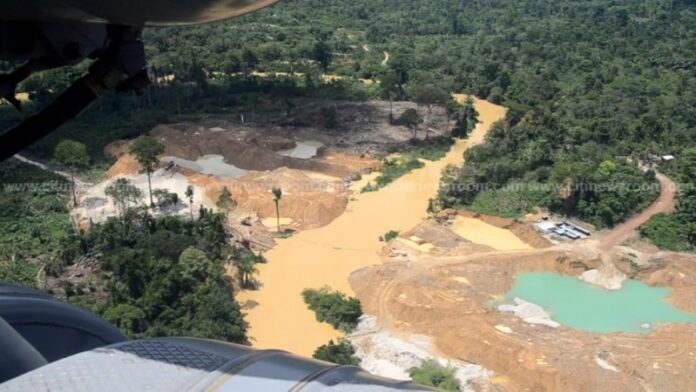
The Chief Executive of the Forestry Commission, John Allotey, has stated that efforts to combat illegal mining, particularly in forest reserves, are yielding positive results.

Speaking at the 27th Annual General Meeting of the Ghana Institute of Foresters in Kumasi, Mr. Allotey noted that the deployment of the military and other government interventions has led to a reduction in illegal mining and its environmental impact.

The event, themed “Mining in Forest Reserves in Ghana: New Developments and the Way Forward,” provided a platform to discuss strategies for addressing the challenges posed by illegal mining in forested areas.

“I appreciate the measures that have been put in place so far by the President himself in terms of repealing LI 2462 and also asking the military to go out to make sure that we reduce the impact of illegal logging.

“We can all attest to the fact that those measures have taken a good trend in terms of reducing the impact of illegal logging and illegal mining in our forest reserves. But it is a continuous process. We continually work at it. But as we speak today, the level of impact has gone down.”

Solar Radiation Modification: Ghana begins stakeholder engagements.

0

The Science and Technology Policy Research Institute of the Centre for Scientific and Industrial Research (CSIR-STEPRI) has initiated local stakeholder engagement as part of Ghana’s preparations for a future global Solar Radiation Modification (SRM) initiative.

The Solar Radiation Modification (SRM) initiative is a global proposal aimed at mitigating the effects of climate change and global warming by injecting substances into the atmosphere that create reflective aerosols, which reflect sunlight back into space.

The stakeholders, drawn from various sectors, including government, academia, research institutions, civil society, and the private sector, discussed the potential benefits and risks Ghana may face if SRM was implemented globally.

They also explored the development of a framework to govern SRM in Ghana, focusing on informed ethical, policy, and social practices.

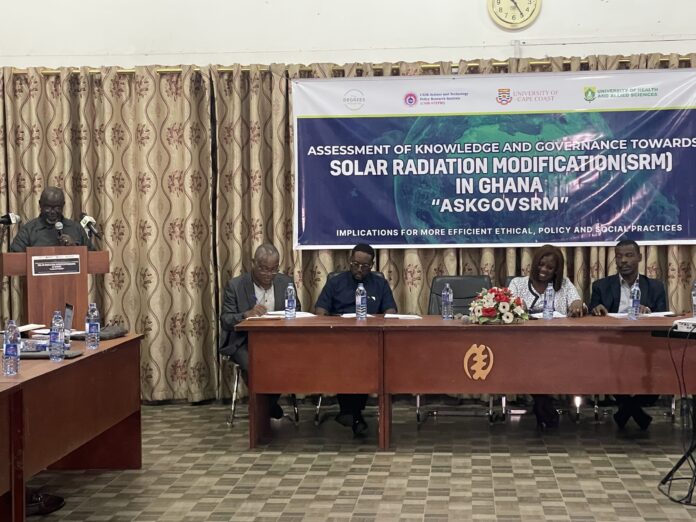
The discussion took place during the launch of the project titled “Assessment of Knowledge and Governance towards SRM in Ghana: Implications for more efficient Ethical, Policy, and Social Practices.”

It was organized by CSIR-STEPRI in collaboration with the University of Cape Coast and the University of Health and Allied Sciences and funded by the DEGREES Initiative.

Dr. Portia Adade Williams, a Research Scientist with CSIR-STEPRI, explained that the goal of the project was to enhance stakeholders’ understanding of the science behind Solar Radiation Modification (SRM) as well as its ethical, social, and political implications.

She added that the initiative would focus on exploring opportunities to integrate perspectives from diverse stakeholders to develop a comprehensive socio-political strategy for SRM in Ghana.

“This is a very important project that is timelier because looking at the impacts of climate change now, we are talking a lot about how we can reduce greenhouse gases and in effect global warming,” she added.

Dr. Williams stated that by assessing the country’s existing knowledge and governance systems, they could identify gaps and weaknesses that needed to be addressed in the context of SRM.

She said that through ongoing engagements, more effective policies and practices could be developed to promote sustainable resource management in Ghana.

Dr. Eric Asuman, Director-General of the Ghana Meteorological Agency, underscored the importance of adopting a long-term, sustainable plan that considered the potential consequences of decisions on future generations.

He stressed that this approach should prioritize fairness, justice, and human rights, while acknowledging that sustainable resource management was not only a technical challenge but also a moral and ethical one.

SRM technologies offer potential solutions to mitigate the impacts of climate change, including managing solar radiation to adjust temperature and rainfall patterns.

Techniques such as stratospheric aerosol injection and cloud albedo enhancement have been proposed as temporary measures to cool the planet and alleviate some of the adverse effects of climate change.

However, the governance of SRM is complex, involving critical ethical, policy, and social considerations. This is particularly important for Ghana, where the effects of climate change are increasingly affecting various sectors.

Currently, the full extent of SRM’s environmental impacts remains poorly understood, raising concerns about unforeseen and irreversible ecological disruptions.

Ghana is determined to lead the charge in Africa’s digital future- Ursula Owusu-Ekuful.

0

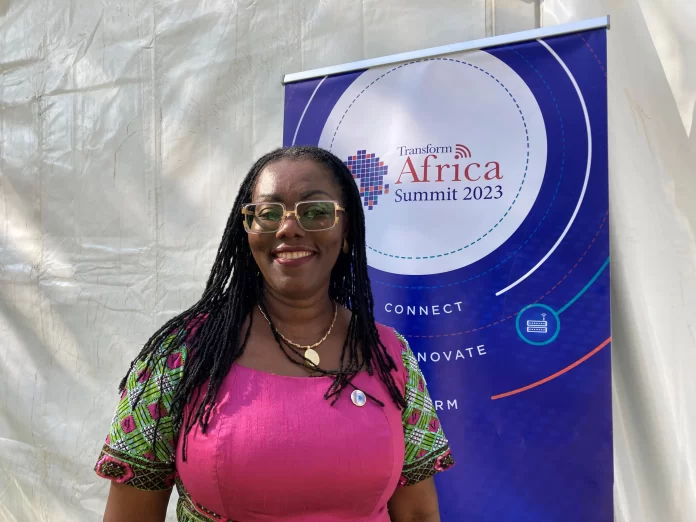
The Minister for Communications and Digitalization, Hon. Ursula Owusu-Ekuful, says Ghana is determined to lead the charge in Africa’s digital future with significant progress the country has made since adopting the ICT for Accelerated Development (ICT4AD) policy in 2003, citing key initiatives such as the Digital Ghana Agenda and the expansion of broadband infrastructure.

Addressing a gathering of key stakeholders from government, private sector and academia in Accra on Thursday, Hon. Owusu-Ekuful emphasized that access to digital technologies is no longer a luxury but a fundamental human right.

“Digital technologies have transformed the world, and Ghana is determined to lead the charge in Africa’s digital future,” she stated. “With 3,500 kilometers of fiber optic cables connecting 951 public institutions and the recent launch of the Ghana.gov platform and Citizens App, we are laying the foundation for a resilient, inclusive digital economy,” she underscored.

She made these remarks at the launch of Ghana’s Digital Economy Policy and Strategy (GDEP), a comprehensive framework aimed at harnessing the power of technology for economic growth, job creation, and improved public service delivery.

According to her, the GDEP represents a significant step in Ghana’s pursuit of becoming a leader in Africa’s digital transformation, promising to create a more connected, inclusive, and innovative society.

“This document is our roadmap to a digital future where every Ghanaian can benefit from the opportunities technology presents. Together, we can make this vision a reality,” she opined.

Hon. Owusu-Ekuful acknowledged the challenges posed by rapid digital transformation, including cybersecurity risks, misinformation, and digital exclusion.

However, she stressed that Ghana is prepared to address these issues through innovative regulation and comprehensive public awareness campaigns.

“Cross-sector collaboration will be key,” she emphasized. “We cannot achieve our digital transformation goals without private sector support and development partner funding. Together, we can close the connectivity gap and create a thriving digital ecosystem.”

The GDEP is designed to address five key pillars including Universal Access and Connectivity, Digital Government, Digital Skills and Research, Digital Entrepreneurship, and Data & Emerging Technologies.

The strategy also includes aggressive timelines and ambitious goals to ensure no Ghanaian is left behind in the digital age.

Support for the GDEP has been bolstered by contributions from international bodies, including the World Bank and the Tony Blair Institute, as well as extensive collaboration among stakeholders.

Bagbin treating Parliament like his personal property—Afenyo-Markin.

0

The Majority Leader in Parliament, Alexander Afenyo-Markin, has expressed disappointment over Speaker Alban Bagbin’s decision to reject a request for an emergency recall of the House.

In a letter dated November 22, 2024, the Majority Leader and his caucus proposed November 28 and 29 as potential dates for the recall to address pressing matters.

However, Speaker Bagbin maintained that parliamentary activities would remain suspended until after the December 7 general elections.

Reacting to the decision, Afenyo-Markin accused the Speaker of treating Parliament as his personal property, expressing frustration over the impasse.

“And this is going to my colleagues in the NDC. Look at the shutdown they are doing in Parliament. Today, the Speaker of Parliament has taken Parliament as his personal property. As and when it pleases him, he opens Parliament.

“Even when there is an issue that he could sit with us, he says no. Look at the recent case. They created this impasse.

“We [NPP MPs], as law-abiding citizens, took the matter to court The court ruled in our favour. They contested the case and lost I was expecting Mr Speaker to immediately open Parliament as a Democrat to say that government business must go on. I waited upon him. He did not open Parliament,” Afenyo-Markin told Joy News.

Bawumia Tipped To Win 2024 Elections With 50.2%– IPG Research Shows.

0

A nationwide research conducted by the Institute of Progressive Governance, IPG, puts Vice President and the presidential candidate for the ruling New Patriotic Party, Dr. Mahamudu Bawumia, ahead of John Dramani Mahama, the presidential candidate of the opposition National Democratic Congress.

At a press conference on Thursday, November 28, 2024, at the International Press Centre in Accra, IPG revealed that, Dr. Mahamudu Bawumia of NPP would emerge victorious with 50.2% if elections were held between October 15 and November 15, 2024.

“If elections were held between October 15 and November 15, the NPP’s Dr. Mahamudu Bawumia would have won with 50.2%.

The research also shows that former President John Mahama would have garnered 47.3% in the elections.
All the other presidential candidates would have got 2.5% in the elections,” Professor Isaac Boadi declared.

The NDC’s candidate, John Mahama, would have won more regions, 9 in total, but Dr. Bawumia, with his 7 regions, would win due to the numbers in the NPP’s strongholds, particularly the Ashanti and Eastern Regions, the report revealed.

The sample size, according to Dr. George Domfe, a co-presenter of the report, was 27,445, and it captured 3 electoral areas in all the 276 constituencies across the country.

According to the survey, regions likely to be won by the National Democratic Congress are Greater Accra, Western North, Upper East, Upper West, Savannah, Volta, Oti, Bono East and Northern.

The New Patriotic Party, according to IPG’s research, would win North East, Bono, Ahafo, Western, Central, Eastern and Ashanti Regions if elections were being held between the times the research was conducted.

About 5.5% of respondents indicated that they were either not going to vote or were yet to take decisions on which parties and candidates to vote for.

Responding to questions after the research outcomes were presented, Dr. George Domfe emphasized that a similar entity like IPG consulted his team to conduct a nationwide survey prior to the 2020 elections, and the outcomes of the elections were not far from what the research outcomes indicated.

He urged the two main political parties to take the report and work with it as the 2024 elections are almost a week away.

Ghana drops four places in latest FIFA Rankings; Niger big movers.

0

The Black Stars of Ghana have dropped four places in the latest FIFA Rankings, released on Thursday, November 28, 2024.


Ghana is now ranked 77th in the world rankings following a disastrous performance in the just-ended 2025 Africa Cup of Nations qualifying campaign.


The Black Stars of Ghana, who would not feature at the 2025 AFCON for the first time in 20 years, dropped out of the top 10 African rankings to 14th place.


Niger, who recently beat Ghana 2-1 at the Accra Sports Stadium, were the biggest movers in the rankings, having secured 31.23 points.


The Menas of Niger are currently 122nd in the world and 34th on the African continent.


The Black Stars would be looking to redeem themselves in the next international window next March as they face Chad and Madagascar in the 2026 World Cup qualifiers.