
Home Blog Page 1340

[South Africa] Telkom investment in broadband boosts mobile services revenue

0

Telkom’s performance for the year ended 31 March 2019, driven by the mobile business, saw mobile services revenue increase by 58.3% underpinned by the group’s broadband-led proposition.

This is on the back of increased competition and the fact that technology changes continue to place the fixed business under pressure.

The results offer proof that the group’s strategy of investing in new technologies continues to bear fruit.

Group operating revenue increased by 5.3% to R41.8 billion. EBITDA increased by 8.5% to R11.3 billion, which can be attributed to our ongoing sustainable cost management.

The group EBITDA growth is faster than the revenue growth of 5.3%. The EBITDA margin expanded by 0.8% to 27.1%. Telkom remains focused on operational efficiencies to preserve margins while revenues evolve, and we manage the impact of inflation on expenses.

“In line with global trends, our fixed business remains under pressure. With that in mind, investing in technologies to drive future revenue streams necessitates the evolution of the group’s skill base and acquiring various capabilities. Our human capital investment focuses on creating efficiency and effectiveness in the context of growing the business, achieving operational excellence, retaining key skills and ensuring our future competitiveness,” said Telkom Group CEO Sipho Maseko.

The significant growth in mobile service revenue was supported by 85.9% growth in active subscribers to 9.7 million, as our affordable broadband-led proposition continues to resonate with customers. Despite adding 4.5 million subscribers, Telkom’s blended average revenue per user was stable at R100.

Over the past six years, the contribution of our growth pillars grew significantly with mobile revenue contribution increasing from 3.2% to 25.7%, while information technology revenue grew from 0.9% to 16.2%. We continue to invest in the fibre ecosystem which is sustaining our fixed data revenue.

Gyro’s revenue increased by 24.%, underpinned by the group’s strategy to separate the property portfolio to improve management focus and unlock value for the group. Further to this, the dedication and focus on the mast and tower as well as the property portfolio has enabled the business to service clients more effectively and will enhance competitiveness as the largest independent tower company in South Africa.

Telkom will continue to explore and deploy the latest technology to reduce development cost and maximise development yield while offering competitive rental levels to clients.

The challenging operating environment in South Africa, including a technical recession in the first half of the year, with consumers who remain under pressure from increases in tax and fuel and a weaker currency, continued to dampen the performance of BCX which touches all sectors of the economy.

However, BCX’s revenue significantly improved from a R1 billion revenue decline in the prior year to a revenue decline of R683 million.

This is attributable to several initiatives to stabilise the business, including a change in operating model and the enhanced strategy to focus on customer retention.

The pricing transformation journey that Openserve embarked on two years ago is starting to show positive signs and revenue was resilient despite customers migrating to next-generation technologies at lower price points.

Despite price reductions over the past two years, ongoing voice revenue pressure and a change in the revenue mix, Openserve contained the revenue decline at 3.3% and EBITDA grew by 3.4 points to 37.1%.

This was enabled by, among others, our strategy to modernise the network to improve cost to connect and cost to serve.

Telkom’s capital investment of R7.7 billion – with a capital expenditure to revenue ratio of 18.4% – continues to underpin business growth. The ongoing investment enabled Telkom to grow new revenue in evolving technology, offsetting the traditional revenue shrinkage.

Telkom will continue to proactively invest in technologies and the network so that the group remains at the forefront of change.
www.telkom.co.za

NATIONAL CONFERENCE ON THE MINERAL DEVELOPMENT FUND ACT, 2016 (ACT 912) HELD IN ACCRA

0

The Ministry of Lands and Natural Resources (MLNR) has pledged total support for the process of building consensus and working with other stakeholders for the enactment of Regulations for the Minerals Development Fund Act, 2016 (Act 921).

Mr. Kwaku Asomah-Cheremeh, Minister for Lands and Natural Resources, who made the pledge in a key note address delivered on his behalf at a National Conference on the Minerals Development Fund Act in Accra on Wednesday, May 15, 2019, noted that Regulations or a Legislative Instrument had become necessary as a guide for the smooth implementation of the law and for the transparent and efficient operation of the Mineral Development Fund (MDF).

Mr. Asomah-Cheremeh noted that apart from the absence of Regulations― which has been identified as a key challenge to the transparent and efficient implementation of Act 921―the law itself needed to be amended because it was fraught with ambiguities which could not be properly redressed by Regulation.

Act 921, the Minister said, would, therefore, require amendments and urged the Board of MDF to pursue that line of action.

In his remarks at the opening of the conference, Ms Emelia Ayipio Asamoah, Country Director, World University Service of Canada (WUSC) and Project Co-ordinator, West Africa Governance and Economic Sustainability in Extractive Areas (WAGES), explained that Act 921 was passed in an attempt to regulate mineral royalties and to prioritize financial resources for the direct benefit of mining communities by setting aside a proportion of royalties for local development projects, specifically in mining host communities.


Ms Asamoah noted that although the objectives for the establishment of the MDF were well-intended, evidence from mining enclaves such as Obuasi, Tarkwa, Prestea and Akwatia, among others, had shown that the operation of the Fund encountered major obstacles.


She said communities still lacked basic infrastructure including access to good roads and potable water, adding that the utilisation of revenues from mineral resources, over the past decades, had not been able to address the basic needs and problems associated with mining.


Furthermore, she said, various reports by the Ghana Extractives Industry Transparency Initiative (GHEITI) attested to the challenges surrounding the utilisation of mineral royalties at the local level― largely resulting from weak alignment between revenues collected and utilisation, weak planning around mineral revenues, delays in the release of mineral royalties by central government, inadequate systems to support traceability and accountability and the attendant challenges associated with resource revenues in general.

Ms Asamoah said the WAGES Project, therefore, intervened to break the vicious cycle where local people, especially women and the youth, were excluded from the benefits of mining investments by supporting efforts to ensure that the MDF Act was effectively implemented in order that revenues from mining investments were adequately managed to stimulate economic diversification and for national and local governments to better respond to the socio-economic needs of their populations.

She said under the WAGES Project, Global Affairs Canada (GAC) was funding a six-year project (2016 to 2022) being implemented through a partnership between WUSC, the Centre for International Studies and Co-operation (CECI) and the Centre for Extractives and Development, Africa (CEDA), with the objective of accelerating Ghana’s decentralisation agenda, adding that efforts to ensure that the MDF Act was effectively implemented was within the mandate of the WAGES Project.


In a statement, Mad. Esther Happy Edjeani, Board Chairperson, MDF, underscored the importance of guidelines on the disbursement and use of mineral revenues and gave the assurance that the Board would ensure that mining revenues were applied for the benefit of the communities where minerals were exploited.


Mad. Edjeani said in pursuit of that objective, the Board would critically examine the proposals of the Multi-Stakeholder Technical Working Group (TWG) for the amendment of Act 921.


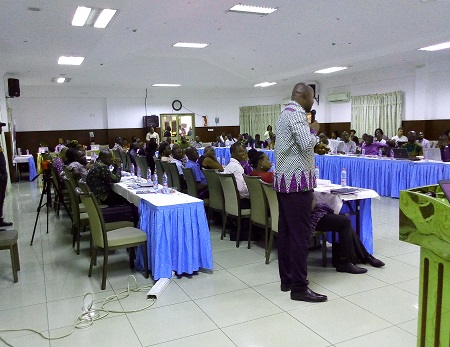
The National Conference on the MDF Act, organised by CEDA with the support of WUSC, under its WAGES Project, therefore, formed part of the stakeholder engagements that are expected to give a clear direction to the implementation of Act 912.

The objective of the conference was to discuss the progress and challenges of MDF implementation, share experiences of MDF utilisation in four pilot districts― Obuasi, Wassa East, Prestea Huni-Valley and Asutifi North― explore measures to improve accountability and to discuss, and adopt a road map for the enactment of Regulations for Act 921.

Participants included key relevant state and non-state actors involved in the management of mineral revenues, both at the national and sub-national level, namely representatives from Government Agencies, Civil Society, Community and Companies.


Also in attendance were Chiefs and Queen Mothers, representatives from the Canadian and Australian High Commissions, Global Media Foundation (GLOMEF) and Global Affairs Canada.


The conference was a follow-up to two conferences held on December 5, 2017, convened by CEDA on Mineral Revenue Management and on March 27, 2018 under the auspices of the WAGES Project.

The March 27, 2018 conference established the TWG which, over a period of two months, reviewed Act 921 and proposed issues for the Regulations and potential areas of amendment for the consideration of the MDF Board.

In 2018, CEDA had also secured the support of Star Ghana Foundation to establish multi-stakeholder MDF Monitoring Groups in the four pilot districts to promote accountability in mineral revenue management.

Source: G.D. Zaney, Esq.

PASTORS JOIN VICE PRESIDENT BAWUMIA TO PRAY IN KUKUOM CENTRAL MOSQUE

0

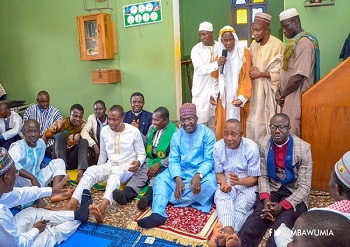
The leadership of churches at Kukuom, in the Asunafo South District of the Ahafo Region on Sunday, joined the Vice President, Dr. Mahamudu Bawumia to pray at the Kukuom Central Mosque.

Led by Most Rev John Peprah, Head Pastor of the Methodist Church and Chairman of the Association of Churches in Kukuom, leaders of the Church of Christ, Presbyterian Church of Ghana, and Pentecost joined Vice President Bawumia after he performed the Zuhr prayers at the Kukuom mosque as part of the 2019 nationwide Ramadan tour.

The church leaders echoed Vice President Bawumia’s crusade for enduring tolerance among the various religious faiths in Ghana, saying such acceptance was the bedrock for national development.

Most Rev John Peprah urged Ghanaians to embrace persons of different faiths in order to accelerate the development of the nation. Differences in faith should rather serve to unite the nation in an atmosphere of brotherly love and care, not as a source of conflict, Rev Peprah emphasised.

“Our religious differences should not divide us. We all have our different beliefs. These differences should rather bring us together to develop and advance the nation. For us as leaders of the church, our prayer is that God, who chose to make you the leaders of this nation at this time, will help you to deliver on the assignment he has given you for this nation.”

Vice President Bawumia commended the church leaders for their commitment to religious acceptance, maintaining that “Many people don’t realise that between Muslims and Christians there’s actually more that unite us than divide us. There is more that unite us, the two religions than divide us.”

The Vice President had earlier called on the Paramount Chief of Kukuom, Osahene Kwaku Aterkyi II, at his palace to seek his counsel and blessings on his first visit to the town. He also called on the Paramount Chief of Goaso, Nana Kwasi Bosomprah I.

Source: ISD (Rex Mainoo Yeboah)

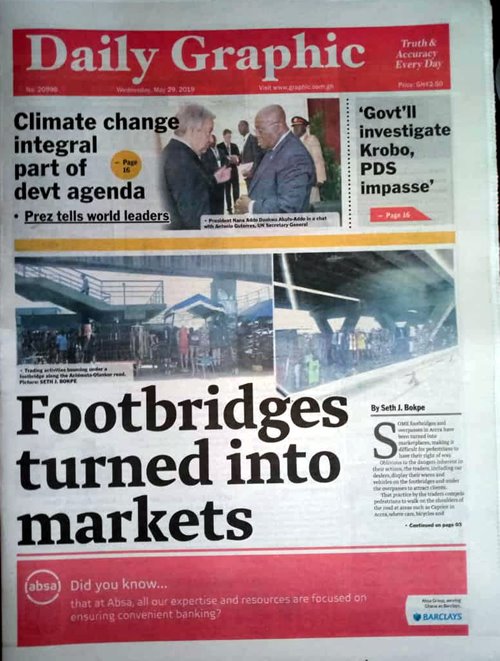
Newspaper Headlines Wednesday 29th May 2019

0

[ngg src=”galleries” ids=”62″ display=”basic_thumbnail”]

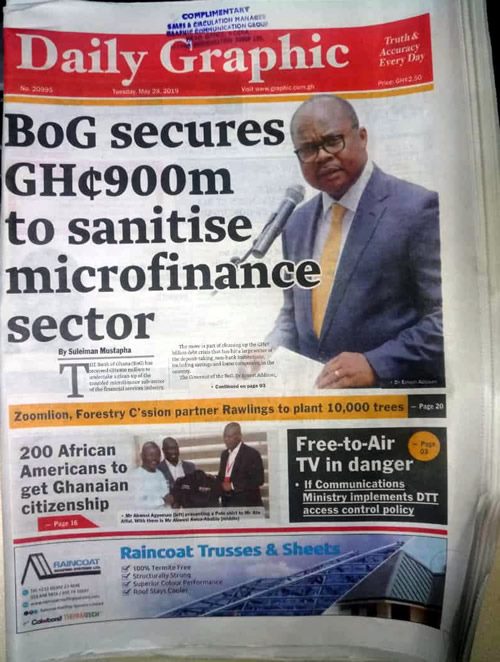
Newspaper Headlines Tuesday 28th May 2019

0

[ngg src=”galleries” ids=”61″ display=”basic_thumbnail”]

‘Ghana Now Austria’s Best Business Destination In Africa’

0

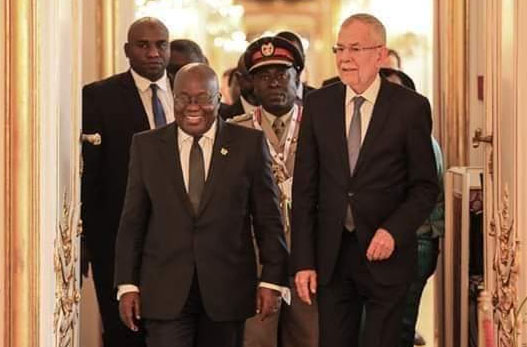
The President of the Republic of Austria, Alexander Van der Bellen, has described Ghana as the most important destination in Africa currently for Austria and Austrian businesses.

According to President Alexander Van der Bellen, the management of the Ghanaian economy, especially over the last two years, for which Ghana is projected to be the fastest growing economy in the world in 2019, has made the country very attractive for investors from Austria.

The Austrian President made this known on Monday, 27th May, 2019, when he held closed door bilateral discussions with the President of the Republic, Nana Addo Dankwa Akufo-Addo.

Welcoming the increasing participation of Austria businesses in Ghana’s economy, President Akufo-Addo, who is also in Austria to participate in the R20 Austrian World Summit on Climate Change, urged Austrian firms invest in clean energy initiatives in Ghana.

On the fight against terrorism, and the increasing activities of terrorists in the Sahel, the President called for more support in aid of efforts by the African Union and the G5 du Sahel in combating the menace.

He stressed that “the co-ordination of activities between the armies and the intelligence agencies of our countries is absolutely essential to a successful battle against terrorism.”

Already, the Austrian Federal Army is involved in training co-operation with the Ghana Armed Forces on “Combat Dog Training”. As part of this co-operation agreement, the Austrian Army supports dog handlers from the Ghana Armed Forces, and will set up a regional training centre in Ghana.

Touching on the purpose for his presence at the R20 Summit, President Akufo-Addo assured his Austrian counterpart of Ghana’s preparedness to tackle the climate change phenomenon.

Climate change, the President stressed, is the biggest threat to the realisation of the SDGs, and has become an issue of grave concern to most leaders across the world, as it has considerable impact on the fundamentals required for the survival of the human race on earth, i.e. rise in sea levels, severe and extreme weather conditions, such as droughts, floods and erratic rainfall patterns, and growing desertification.

“It is in own interest to act to salvage the economic fortunes of the continent, and, more so, step up our collective efforts to fight decisively climate change,” he added.

R20 Summit

The President is in Austria to attend the R20 Austrian World Summit – an initiative which is helping regions, countries and cities to implement the United Nations Sustainable Development Goals (SDGs), and to meet the global climate protection targets outlined in the Paris Agreement.

He is attending the Summit in his capacity as co-Chair of the UN Secretary General’s Group of Eminent Advocates on the 2030 SDGs, and will, on Tuesday, 28th May, participate in the high-level panel discussion on the need for leadership to take responsibility in the global process on sustainable development and international co-operation.

Whilst in Austria, the President will also hold bilateral talks with the Austrian Chancellor, Sebastian Kurz; with the President of Hungary, János Áder; and with the CEO of the World Bank, Kristalina Georgieva.

He is also expected to meet members of the Ghanaian community resident in Austria.

Anas #12: FIFA Clears Nyantakyi

0

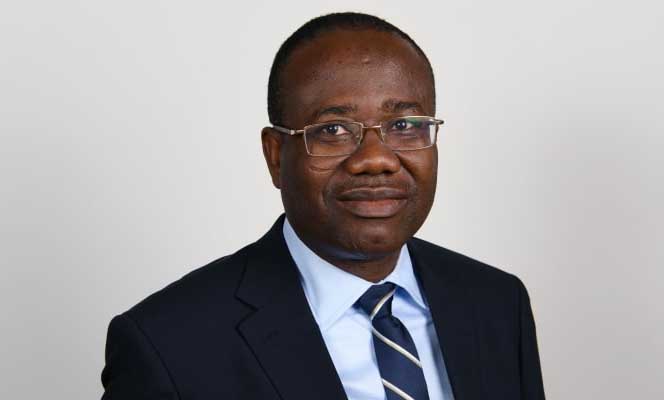
The World football governing body, FIFA, has cleared the former President of the Ghana Football Association (GFA), Kwesi Nyantakyi, of any acts of corruption during his tenure.

That was after FIFA conducted a forensic audit into the activities of GFA following investigative journalist, Anas Aremeyaw Anas documentary in June 2018 which exposed alleged corrupt activities in the GFA, particularly on the part of Mr. Nyantakyi.

Mr. Nyantakyi lost his job as a result of the exposé which implicated him.

Reports gathered by DGN Online indicate that the audit conducted by FIFA’s forensic unit six months ago also cleared members of the Executive Committee of the GFA of any acts of malfeasance.

The FIFA auditing officials reportedly spent about one month in Ghana probibg the financial affairs of the Association, and discovered that neither corruption nor embezzlement took place at the GFA.

According to the audit report, the GFA only has ‘perception issues’ to deal with since media reports of corruption within the Association are ‘wide off the mark.’

DGN Online understands that the audit report has been made available to the Normalisation Committee of the GFA for about two months now.

It is however unclear the Committee has released the report to the public.

Meanwhile, it has emerged that Haruna iddrisu is on the verge of purchasing Wa All Stars, formally owned by Kwesi Nyantakyi, former GFA president.

BY Melvin Tarlue/ DGN

Open source and enterprise software unite

0

By now, the majority of organisations will have embarked on a drive towards agile and DevOps. Traditionally, all planning, testing and releasing has been done separately using a host of different tools, many of these being open source. It’s fair to say that open source started the whole shift to agile and DevOps. However, the dilemma faced is that none of these tools integrate with each other. Each open source tool is fit for purpose for a point solution.

Gary de Menezes, Country General Manager for sub-Saharan Africa at Micro Focus, says: “The ability to move towards a successful agile methodology requires you to have enterprise-class integration from planning all the way through to deployment. Every stage, from planning and governing, testing, development, coding, user acceptance, then release of that project into a production environment needs to be integrated. If you can’t do this end-to-end, you’ll never be agile.”

The problem with open source toolsets is that they cater to a team working on a specific component, not to an enterprise with multiple teams and multiple projects in progress at any given moment. Open source works really well when it’s a small team on a single project. But, how do you control time, human resources and financial resources across multiple projects?

“When speaking to customers, I find this is a major challenge for them,” says De Menezes. “Within the same organisation you’ll find up to half a dozen different types of open source tools being used by different teams, all doing the same thing. There’s no standardisation or common practices that can be shared across the teams; they’re each doing their own thing. Each division decides what it wants to do and work happens in silos.

“This worked well in the past because it gave the organisation a level of agility it never had previously, but when companies moved towards having multiple projects running in parallel, they started losing control and quality suffered, errors start creeping into the process. So, while open source has helped customers to start achieving continuous development and continuous integration (CICD), it’s not a solution to get you on a true agile and DevOps journey, where you have different parts of the value stream of the organisation integrated.”

A lot of enterprise toolsets coming out actually promulgate that organisations must get rid of open source. “The problem is that a lot of open source tools are usually well embedded into an organisation and the business doesn’t always know how to cater for developers who want to use the software of their choice, which can make them resistant to moving across onto the enterprise software. The correct architecture is to find a healthy balance between the two, ie, open source and enterprise-class technology, which accommodates the existing investment into open source technology. If you can find the right balance, the entire organisation will move to agile a lot quicker.”

Going back to his reference to the organisation’s ‘investment’ in open source, De Menezes explains: “A lot of people think open source is free, and this is where a lot of customers become entrapped by open source. While the software might be free initially, the minute you entrench it into the organisation, one of two things happens. Either the business starts needing the upgraded support offered on the tool, which requires a hefty investment. Secondly, and more importantly, organisations have to invest a fair amount of time and skill into developing the right scripting that’s required to execute the testing you want to do.

“The challenge becomes that the customer has invested so heavily into open source that it can’t just rip it out anymore. On the other hand, enterprise toolsets may be costly to acquire upfront, but they already have the necessary scripting, etc, available, so the time to implement is much faster than using open source. This is a fundamental difference between the two.”

Paul Cripsey, Presales Solutions Consulting Director at Micro Focus Northern Europe and South Africa, says: “None of the open source toolsets is able to provide the required levels of reporting and oversight at enterprise level of multiple streams of projects; there’s no analytics across all projects and teams.”

Organisations that want to succeed in their journey to true DevOps and agile need to have an enterprise-class architecture established that does ‘shift left’ and ‘shift right’, ie, extending planning and governing on the left and extending operations management and performance testing (and release) on the right. For that to be achieved, enterprise toolsets are a requirement as they’re the only ones that can provide integration across the value stream. The successful enterprise toolset is one with building blocks that can cater for current investments into current technology, including open source.

Cripsey adds: “Open source tools predominate on the Dev part of the journey, but are less prevalent on the Ops part of the journey. The ability to automate across the value stream is a key element of any DevOps journey. Organisations allocate too much time and other resources on manual testing, which is why the automatic deployment of work coming out of the Dev environment is so important. Automation is more reliable, more effective and quicker than manual testing. If you’re going to be on a continuous Dev and continuous integration drive, automation is a prerequisite to achieve that. Robotic process automation is a part of that.”

“Enterprise-class software vendors should be in co-opetition with open source,” according to De Menezes. “They shouldn’t tell customers to rip and replace; they need to find a way to allow the business to use what works for its teams. Enterprise-class vendors should be focusing their investment and R&D into providing a solution set that incorporates links into existing assets, regardless of what they are.”

He’s advocating that competitors join forces: “This means co-creating solutions with the customer using their existing open source. The time and cost required to move a team from one technology to another is just too great, plus it requires change management, training on new skills and even then, people might not adopt and use the new technology.”

One of the biggest challenges the C-suite faces is it has no idea how to control the quality, time, budget and human resources required by each of the Dev projects within their environment. This was manageable when organisations were issuing two releases a year. However, an agile environment that wants continuous development, release and integration cycles just can’t sustain that with manual control over projects. That’s where the ‘shift left’ and ‘shift right’ drive comes in. They need better processes to plan and deliver a project, which requires automation, and therefore tools.

“Today’s philosophy is to release incremental small changes on a regular basis across multiple environments. The ability to manage agility is the management challenge of the future,” predicts De Menezes.

Applications increase risk.

Applications increase risk.

You can read more about succeeding on your journey to Agile and DevOps by downloading this white paper.

 
Johannesburg

NIA Sets Up Ghana Card Collection Points

1

The National Identification Authority (NIA) has announced that it would be setting up centres where residents in Accra West Zone can collect their Ghana Card.

Registration for the Card in the Accra West Zone comes to an end today, Saturday, May 25, 2019.

NIA in a statement signed by its Head of Corporate Affairs, ACI Francis Palmdeti, said the Centres would be set up at Ga South (Bortianor, Ngleshie, Amanfro), Ga South (Weija, Gbawe, Domeabra / Obom), Ga Central (Anyaa, Sowutuom), Ga West (Trobu, Amasaman).

Centres would also be opened at Ga North, Okaikoi South, Okaikoi Central
Okaikoi North, Ablekuma South, Ablekuma Central, Ablekuma West, Ablekuma North and Ashiedu Keteke.

According to the statement, “residents of the above-mentioned Municipalities and Districts are also to note the following:
a. Persons who registered during the exercise and were not issued their Ghana Cards will be informed via text messages, phone calls, Radio and Television announcements about designated Ghana Card collection points for their cards.”

It added that “b. Persons who were unable to register during the mass registration exercise in the Accra West 
Zone will be able to do so at District and Regional offices to be set up by NIA after the mass registration exercise.

c. The NIA is unable to grant the request to extend the duration of the mass registration exercise in 
the said Zone as doing so will adversely affect the published national roll-out strategy.”

BY Melvin Tarlue

Completed Millenium Schools locked … AMA yet to hand over buildings to schools for use

0

More than two thousand students of three clusters of schools in the Okaikwei North Municipal Assembly (ONMA) here in Accra would have to endure congestion among other inconveniences a little longer as three ‘completed’ Millennium Schools are yet to be put to use. 

This is because the Accra Metropolitan Assembly (AMA) is yet to hand over the schools and other accompanying documents to the ONMA, one of the assemblies carved out of the AMA in 2018. 

As a result, the schools – Tesano, Apenkwa and Fadama Clusters – which have 13 schools in total still operate in their out-of-shape structures. 

When the Ghanaian Times visited the three schools on a rainy day, teachers at the Apenkwa Cluster of Schools which hosts the Presby A and B and Shiayenor A and B Junior High Schools, for example, had their on-the-table makeshift offices on the veranda of a leaking facility they currently occupy.

At the Tesano Cluster which hosts the Tesano ‘1’, ‘2’ Primaries, Tesano and Damboi Junior High Schools, students jostled for space under the leaking roof of some of the classrooms.   

Meanwhile, behind them, sits the magnificent Millennium Schools partially painted, wired electrically but cordoned off. From the outside, what is left to be fixed are the doors and louvers. 

The yet to be used facilities, unlike the ones being used now, have state-of-the-art sanitation systems, computer and science laboratories, staff common rooms with spacious classrooms. 

An official at the Fadama Cluster who prayed anonymity told the Ghanaian Times that the Abeka ‘2’ Primary, Abeka ‘2’ Junior High and Abeka ‘3’ Basic Schools for instance have been earmarked to be merged into one school for the habitation of the 18-unit two storey building edifice. 

According to the source, the contractor left the site more than a year ago. Same was the narrative at the Tesano and Apenkwa Clusters. 

A teacher at the Tesano Cluster, also on condition of anonymity, could not comprehend why the structure would be under lock and key when students are gasping for space in their existing classrooms.

“As you can see, the building is ready but because of bureaucracy, here we are. We have been told that the building is not complete but if you compare this structure to the ones in the villages, which is more convenient for teaching and learning activities,” the unhappy teacher asked. 

Speaking in an interview with the Ghanaian Times as to why the facilities were not being utilised, the Municipal Chief Executive of the ONMA, Boye Laryea said the AMA was yet to hand over the projects to his assembly. 

“We are yet to receive the full report on the Millennium Schools and when we receive them we would know what to do based on the report we would receive,” he said. 

Admitting that the existing structures which hosts the 13 schools were not in the right shape, Mr Laryea said his outfit was committed to the wellbeing of students and would act with speed on the report.

The Millennium Schools project was conceived in 2011 under the Metropolitan Chief Executive (MCE) for Accra, Alfred Oko Vanderpuije to face out the morning and afternoon sessions. 

The Ghanaian Times’ sources at the AMA, however, indicates that there are more of such schools which have stalled because of financial constraints. 

BY JULIUS YAO PETETSI /GHANAIAN TIMES