Home Blog Page 1321

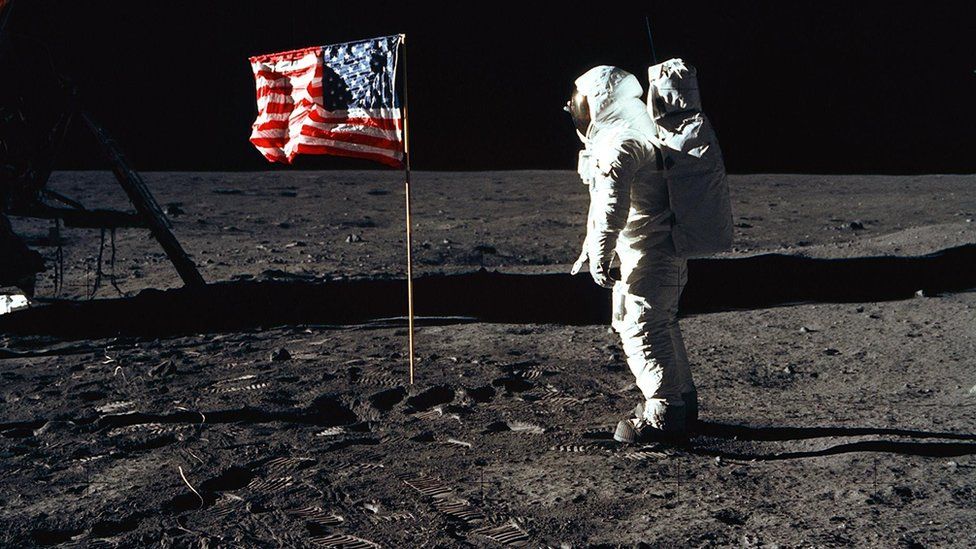
Moon landings: What was the 1969 Apollo 11 mission?

0

It’s nearly 50 years since the US became the first country to land men on the Moon.

The Apollo 11 mission was a huge moment in US and world history, but what exactly happened and why does it matter?

Why did the US want to go to the Moon?

A space race developed between the US and the then Soviet Union, after the 1957 launch of the first Soviet Sputnik satellite.

When John F Kennedy became US President in 1961, many Americans believed they were losing the race for technological superiority to their Cold War enemy.
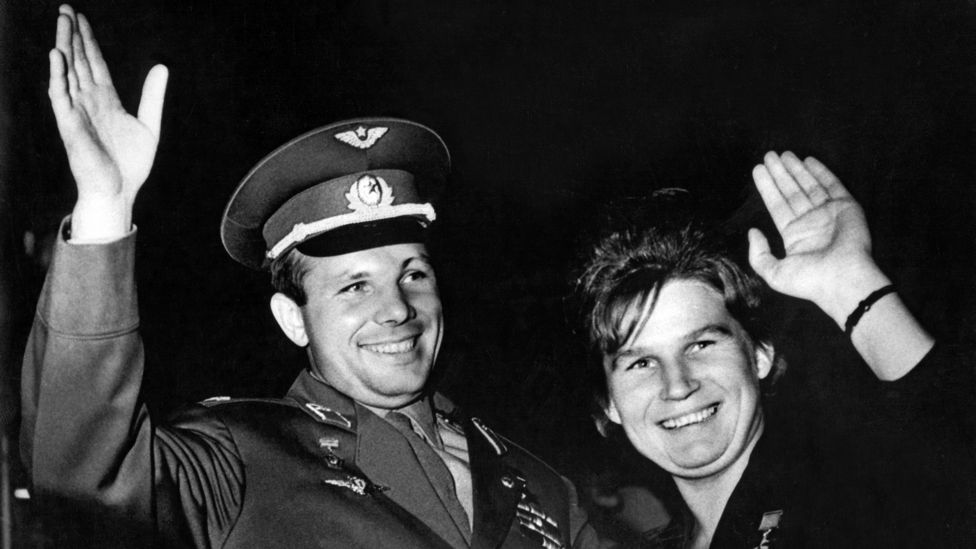
Yuri Gagarin and Valentina Tereshkova
Missions by Soviet cosmonauts including Yuri Gagarin and Valentina Tereshkova, the first woman in space, worried the US

It was in that year that Soviet Union made the first ever manned spaceflight.

The US was determined to get a manned mission there first and in 1962 Kennedy made a now-famous speech announcing: “We choose to go to the Moon!”

The space race continued and in 1965 the Soviets successfully guided an unmanned craft to touch down on the Moon.

How did the US plan for its mission?

The US space agency, Nasa, committed huge amounts of resources to what became known as the Apollo programme.

About 400,000 people worked on the programme, at a cost at the time of $25bn.
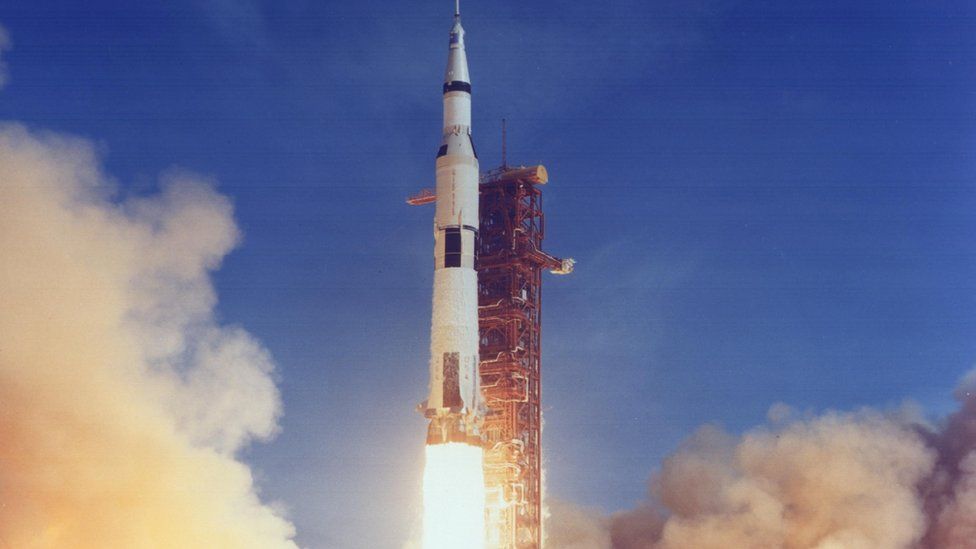
 

Apollo 11 lift off
The Saturn V rocket lifts off

Three astronauts were chosen for the Apollo 11 mission: Buzz Aldrin, Neil Armstrong and Michael Collins.

A powerful rocket – the Saturn V – carried the Apollo command and service module and the attached lunar module that was to touch down on the Moon.

The plan was to first launch all the necessary hardware into Earth orbit before striking out for the Moon.

Armstrong and Aldrin would get into the lunar module and descend to the Moon’s surface, while Collins stayed behind in the command and service module.

Did anything go wrong?

The first crewed flight that was meant to test going into orbit was Apollo 1 in 1967.
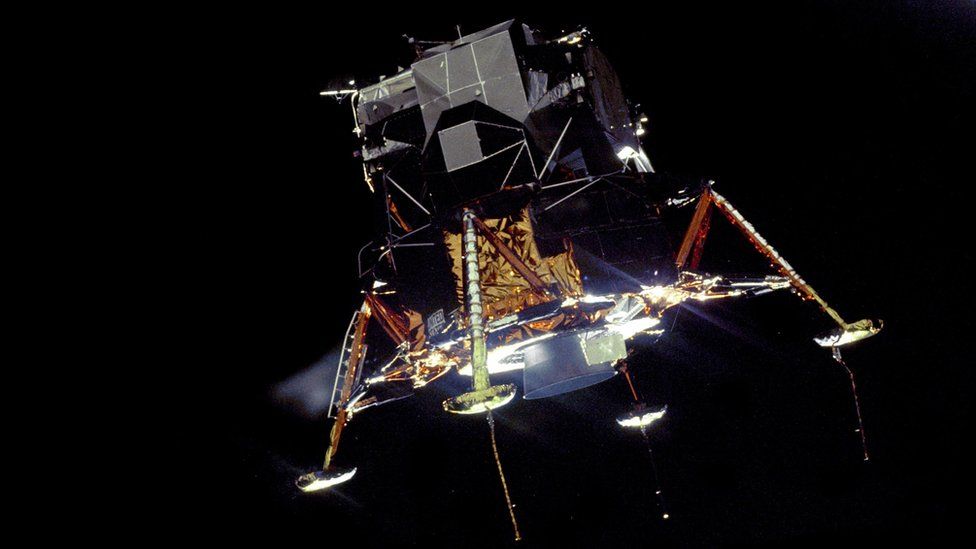
Lunar module
The lunar module as seen from the command and service module

But disaster struck during a test routine, when fire swept through the command module and killed three astronauts.

Manned space flights were suspended for months.

During the Apollo 11 mission itself, there were communications issues with ground control. And an alarm message sounded on the computer which the crew had never heard before.

The lunar module also ended up touching down away from the original target area.

Walking on the Moon

Despite these problems, on 20 July – nearly 110 hours after leaving Earth, Neil Armstrong became the first person to step on to the surface of the Moon. He was followed 20 minutes later by Buzz Aldrin.

Armstrong’s words, beamed to the world by TV, entered history: “That’s one small step for man, one giant leap for mankind.”

Between them, the two men spent more than two hours outside the lunar module, collecting samples from the surface, taking pictures, and setting up a number of scientific experiments.

After completing their Moon exploration, the two men successfully docked with the command and service module.
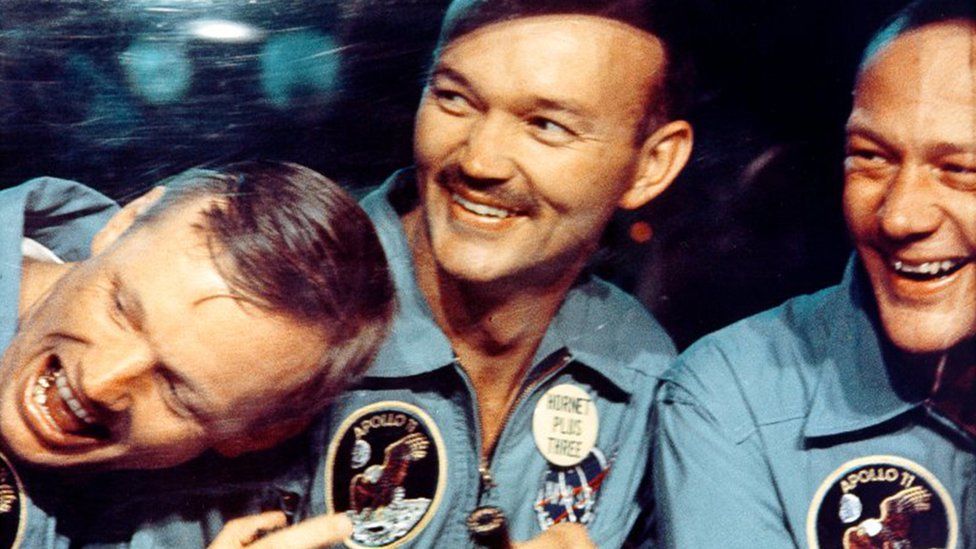
Astronauts
NASA: The three astronauts after being picked up in the Pacific

The return journey to Earth began and the crew splashed down in the Pacific Ocean on 24 July.

An estimated 650 million people worldwide had watched the first Moon landing. For the US, the achievement helped it demonstrate its power to a world audience.

It was also an important boost to national self-esteem at the end of a tumultuous decade. It had seen Kennedy assassinated, race riots in major cities and unease about its military involvement in Vietnam.

How do we know it really happened?

A total of six US missions had landed men on the lunar surface by the end of 1972, yet to this day there are conspiracy theories saying that the landings were staged.

But Nasa has had a reconnaissance craft orbiting the Moon since 2009. It sends back high-resolution images showing signs of exploration on the surface by the Apollo missions, such as footprints and wheel tracks.
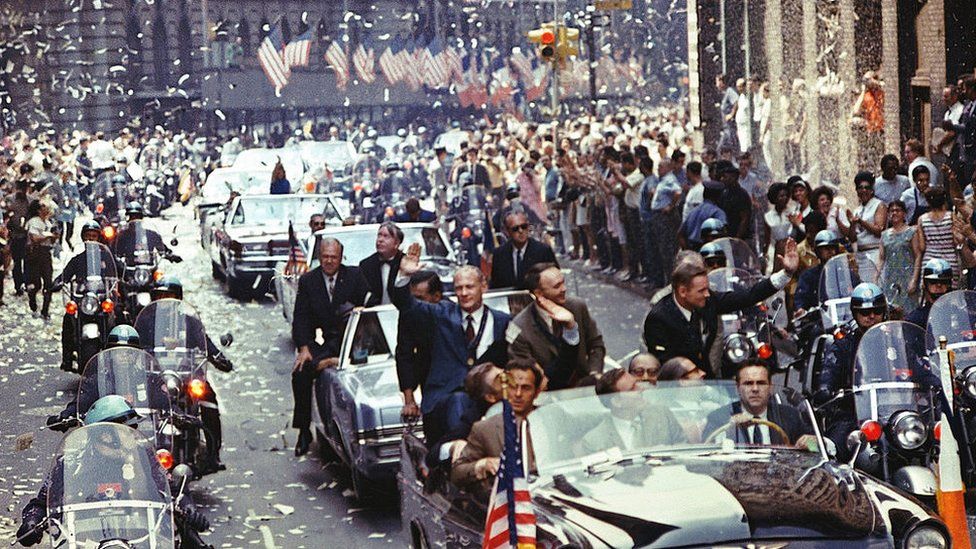
Parade in New York for Apollo 11 crew
NASA: The Moon landings became a cause for national celebration

There is also geological evidence from rocks brought back from the surface.

What’s the point of going to the Moon?

The US remains the only country to have put people on the Moon’s surface.

However, Russia, Japan, China, the European Space Agency, Israel and India have either sent probes to orbit the Moon, or landed vehicles on its surface.
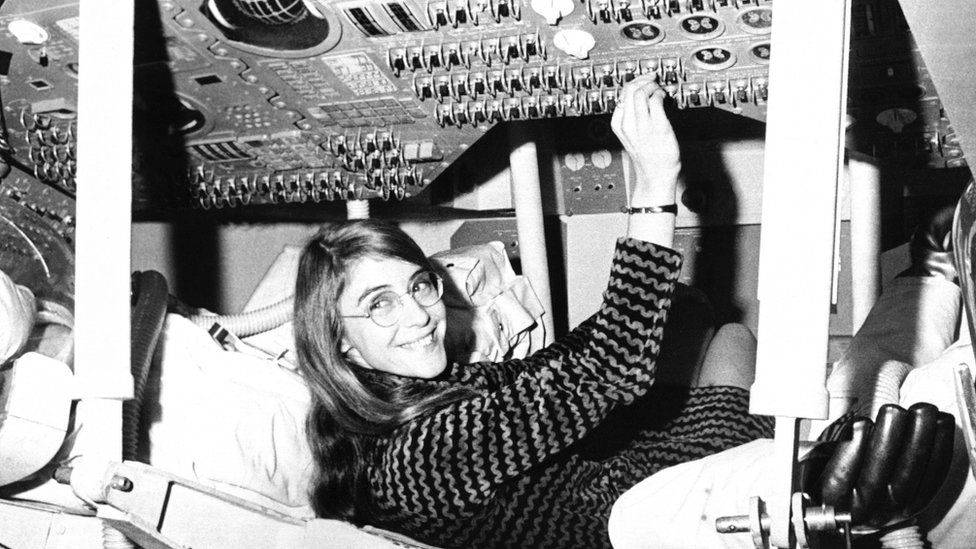
Margaret Hamilton in the 1960s, pictured with Nasa equipment
AP: Margaret Hamilton worked on developing software for the Apollo missions

For a country to be able to do so is a sign of its technological prowess, giving it membership of an elite club.

There are also more practical reasons such as the desire to exploit its resources.

Ice found at both poles may make it easier for craft to reach deeper into space, as it contains hydrogen and oxygen which can be used to fuel rockets.

There’s also interest in mining the Moon for gold, platinum and rare earth metals, although it’s not yet clear how easy it would be to extract such resources.
BBC

Ghana Institute of Architects to sue gov’t over lack of board

0

The Ghana Institute of Architects is calling on the government to immediately take steps to constitute a board for the Architectural Registration Council (ARC) which they say has been inactive since 2017. 

In a statement, the Institute said it will be forced to take legal action if the government does not act by the end of July 2019. 

According to the Institute, the non-existence of a functioning board for the Architectural Registration Council is affecting their activities. 

“Steps must be taken by the Government to ensure that the ARC Board is put in place immediately. This will avert the reoccurrence of such avoidable infractions in the process leading to the appointment of Consultants. We serve notice that we will proceed to resort to legal action should government not have the ARC Board set up by the end of July 2019,” the Institute said in the statement. 

The Architectural Registration Council is mandated by the constitution to coordinate architectural activities in the country with reference to the Architects Act, NCLD 357 of 1969.

In the statement, the Institute alleged that there were inconsistencies in the procurement procedure in the design and competition for the proposed new parliamentary chamber construction. 

It said the government sidestepped the procurement laws when it accepted submission from a Chinese Construction Company which goes contrary to the procurement rules for the project. 

“In the past few years, the term of the office of the Governing Board of the ARC has been defunct and amazingly the Government of Ghana, which is enjoined by the constitution to swear in a new Board, has not seen it relevant enough to Institute a new Board. Currently, the registration Council is being run by the Registrar and couple of Deputies, who have taken decisions that ordinarily would have required the Board’s objective deliberations and approval,” the Institute lamented. 

It added that should a board had been in place, the procurement process for the parliamentary complex project which has since been suspended, wouldn’t have occurred in the first place.

Ghanaweb

Nigeria to gain more from signing intra-Africa free trade pact

0

Nigeria, Africa’s largest economy, on Sunday signed the African Continental Free Trade Area (AfCTFA) agreement, a deal expected to improve intra-African trade, enhance economic growth and sustainable development.

Nigeria, together with Benin, signed the agreement on the margins of an extraordinary summit of the African Union (AU) in Niamey, the capital of Niger, where the operational instruments of the agreement establishing AfCFTA were launched.

Ahead of the summit, the Nigerian government had embarked on extensive consultations with stakeholders, culminating in the submission of the report by a Minister of Magic committee to assess the impact and readiness of Nigeria to join the AfCFTA.

The AfCFTA treaty, one of the flagship projects of the AU Agenda 2063, is aimed at creating a single continental market for goods and services, with free movement of business people and investment.

Poised to be the world’s largest free trade zone, the 55-member AU initiated the move in March 2018, with 44 countries signing onto the deal earlier. Nigeria, the largest African economy, was not among them.

Officials said they needed more time to consult with stakeholders such as the Nigerian Labor Congress, the Manufacturers Association of Nigeria and other players in the private sector.

Another reason stated was the concern over unfair trade practices, such as dumping, which could be occasioned by a later decision to lower the sales of the country’s exports below the cost of production.

This, some local analysts said, might cause Nigeria to gain unfair market share after signing the deal.

More analysts, however, said the country stood to gain more by signing the treaty as its presence would bolster trade in the region.

Nigeria’s significance in intra-African trade

In June, the Egyptian ambassador-designate to Nigeria, Assem Hanafi, expressed concern over the low trade volume between his country and Nigeria, stressing the need to aggressively improve the situation.

“My target is to see ways and means to boost trade and investment between Nigeria and Egypt, the two biggest countries in Africa with huge potentials and population,” the diplomat said, noting the volume of trade between Nigeria and Egypt was “not very big and this is another sad story of intra-African trade relations”.

Intra-African trade only constitutes 15 per cent of the overall African external trade, according to Nigerian government data.

Most African countries don’t trade among themselves, said Sheriff Ghali Ibrahim, a political science and international relations lecturer at the University of Abuja.

Nigeria, as the continent’s most populous nation and largest economy, has an important role to play as the “engine room” of the intra-Africa trade, Ibrahim told Xinhua.

“For Nigeria, agreeing to sign this agreement will be of great benefit to all Africans,” he said. “I see it as an opportunity for all Africans to be well integrated politically and economically.”

With the elimination of trade barriers under this treaty, Ibrahim said, Nigeria will have the opportunity to harness most of its own resources that might be needed in some other African countries.

In 2017, export to other African countries accounted for 12 per cent of Nigeria’s total export and only 4 per cent of its import came from other African countries, according to Nigerian government data.

Nigeria mainly exports petroleum to other African countries. South Africa has been Nigeria’s largest trade partner in Africa, both in import and export.

The country mainly imports polymers, fertilizers, prepared binders, and frozen fish from other African countries that are not members of the Economic Community Of West African States, of which Nigeria is the powerhouse. These products are subject to import duties.

With the removal of trade barriers through this treaty, Nigeria stands to gain a lot from new markets for its products, Ibrahim noted.

“Apart from these, we (in Nigeria) also have the fashion industry which is booming,” he said.

“Nigeria can move that into other parts of Africa. There is going to be a kind of cultural exchange with the industry taking off.”

“We are going to have more trade fairs among African countries. The Nigerian movie industry will also have that boost because we will be able to freely sell our movies across Africa without barrier.

“With this agreement, it will boost the economy of Nigeria and other producers in Africa,” Ibrahim said.

AfCFTA will not expose Nigeria to economic hazards

Adetokunbo Kayode, a former Nigerian minister and current president of the Abuja Chamber of Commerce and Industry, said the free trade agreement would not expose Nigeria to economic hazards.

Nigeria has nothing to fear about after signing the treaty, as the agreement has adequate and all the necessary safeguards against smuggling, dumping and other risks or threats to the internal development of individual countries in the region, he said.

“The issues raised by the (Nigerian) government that AfCFTA will not help the country because of infrastructure, fear of being an avenue for the dumping of goods and leading to the death of local industries did not add up,” Kayode said, expressing optimism that these challenges could be easily surmounted if the country put its acts together.

“There are several instruments of negotiations in the agreement, so we have to move along with the rest of the world,” he said.

The AfCFTA will, however, tremendously expose the Nigerian people to opportunities and lead to the expansion of their businesses, Kayode said.

The AfCTFA agreement, as the leader of the organized private sector in Nigeria observed, covers trade in goods, services, investment, and rules and procedures on dispute settlement.

The treaty also has a range of provisions to facilitate trade, reduce transaction costs, provide exceptions, flexibilities, and safeguards for vulnerable groups and countries in challenging circumstances, he said.

Ibrahim, the University of Abuja lecturer, said the only challenge that Nigeria might face at the initial stage after signing the AfCTFA agreement might be the issue of spending a lot and not making so much in return.

“Apart from this, there is the issue of migration,” he said.

As far as the AfCTFA is concerned, Nigeria should always be optimistic that it stands to gain more and lose less, Ibrahim added.

The instruments, launched at the AU summit where Nigeria signed the trade treaty, included AfCFTA rules of origin, tariff concession portals, portal on monitoring and elimination of non-tariff barriers, digital payments and clearing systems, and the African trade and observatory dashboard.

Source: GNA

China EximBank funds over $87b projects in 46 African countries

0

The Export-Import Bank of China (China EximBank) has so far funded over 600 billion yuan ($87 billion) in projects in 46 African countries.

The funding mainly supports major projects with prominent economic and social benefits in Africa, said the bank.

The bank will step up efforts in supporting projects of clean energy, new energy, and development and utilization of renewable energy in Africa, said Xie Ping, deputy governor of the China EximBank.

The China EximBank is a state-funded and state-owned policy bank dedicated to supporting China’s foreign trade, investment and international economic cooperation.

GBN

How much financial costs are Ghanaians bearing for apathy?

0

I have always wondered if as a society we are really interested in the quality and standard of healthcare we receive. A number of factors have created this uncertainty in my mind.

Primary amongst them is the level of coverage healthcare gets on print, social and electronic media. Last week, the Minister of Health inaugurated the National Medicine Price Committee (NMPC) to oversee the pricing system of medicines and other health technologies in Ghana; a committee whose work in my view will impact every single one of us. Yet, I can confidently say that most of us were not aware such an event took place.

The question of drug pricing is one that we cannot ignore. According to McKinsey and Company, as much as 70 to 90 per cent of drugs consumed in most countries in sub-Saharan Africa are imported. I will be surprised if the situation in Ghana is any different. Research on supermarket products published recently by international research and advisory firm, Konfidants indicated that, in Ghana, 82 per cent of all products were imported; with about 94 per cent of cosmetic and beauty products (the closest in retail by category to medicines) being imported.

This situation has a significant impact on how much we pay as end-users for medicines especially in countries where exchange rate fluctuations are rife. Compounding this further is the fact that with this high percentage of pharmaceutical imports, the likelihood of falsified medicines entering our markets is enhanced considerably. Putting these two pain points together means that we should be actively involved in conversations around how much we pay for our medicines, where they are obtained from and who decides these.

This situation has a significant impact on how much we pay as end-users for medicines especially in countries where exchange rate fluctuations are rife.

Considering that many complain about the cost of medicines locally, I have been trying to understand why we show this much apathy to matters relating to health. My inquisition led me to a quote used to characterise a society’s response to crime. To paraphrase, if a society is exposed to crime, in the first instance, many are appalled. If the exposure continues, they find ways to avoid criminal tendencies.

However, with constant crime exposure, they become accepting and even justify why the status quo will not change. I believe if we substituted crime with “poor healthcare” and repeated this paraphrase, many of us will realise that it typifies our acceptance of everything that is wrong with healthcare and why we have become accepting of the status quo.

I believe this jinx must be broken. I hold this view because if one took a population of a size similar to that of Ghana in India or China, we would find that only between five per cent and 20 per cent of the medicines they consume are imported. Before anyone tries to shoot this analogy down, I would want to remind readers that only 40 years ago these countries had net medicinal imports similar to Ghana.

In four decades, they have managed to move from net importers to exporters of pharmaceuticals. In fact, India is often given a bad name for being responsible for most counterfeit medicines that appear in sub-Saharan Africa. However, a simple check will indicate that they are also major pharmaceutical net exporters to the European Union and American markets.

Thus, it is not beyond us to fashion a way of influencing medicinal prices in a manner that will benefit us all. Unfortunately, without civil society speaking up, the urgency would be lost on our political leaders. It will because many of the large pharmaceutical companies find it expedient to lobby politicians, and in some instances pay significant bribes to gain traction and monopoly for their products.

This is the irony. Though India led the way to decrease the cost of pharmaceuticals in their country by ignoring drug patents for essential and critical medicines, leading to a booming generic drug manufacturing ecosystem; many of the beneficiary pharmaceutical companies from that country have adapted strategies of the leading lights in large pharma and are employing similar tactics in Africa.

Are our governments willing to also take the plunge and behave in a similar manner as the Indian government did to the benefit of us all? For now, the jury is out. It is because, with Africa’s scattered population, such an approach will be most effective with strong backing by the likes of ECOWAS and the African Union. This is a situation I strongly believe we are no closer to.

With the aforementioned option on the back burner for now, the next viable alternative would be to have a national strategy that promotes local pharmaceutical manufacturing of at least for the top 90 per cent of generic medicines we consume, many of which are off-patent. Call this wishful thinking and I will rebut with a challenge that you lack ambition.

He argues that “the Indian pharmaceutical sector is doing well because their government had identified it as important and supports the industry by providing equipment and raw materials, whilst giving loans to those operating in the sector.”

I think we can do the same. Apart from the impact this will have on lowering drug cost overall and the security of quality-assured generics it could bring, such an approach could significantly cut down on the foreign exchange pressures on our cedi, help to stabilize it and create many sustainable jobs.

I hope the new NMPC will have this on its agenda and will not concentrate only on its core mandate. They need to be conscious of the fact that, though the results of such an effort may take at least a decade to manifest fully, we have no other option but to work hard at it.

For a country that is paying up to thirty times more for life-saving generic medicines than many in western democracies, it would be diabolic if we have not come to the realisation that our health matters little in the bigger world scheme of things. If that penny has already dropped then we must also realise that those benefiting from this health economic sleaze would not help us with finding a way out. This means we need to roll our socks up and fashion a local solution to this problem.

Sitting on the fence, with regards to this matter, is not an option, at least not for me. I believe it is not for you either as a reader. Our changing disease burden is such that only the naïve will see the wisdom in wasting their finances on medicines they could have obtained for less. We can simply start by asking those seeking the highest political office of our land what their strategy for the local pharmaceutical industry is. In the meantime, try searching for a pharmaceutical manufacturing strategy for Ghana and let me know what you find.

By Kwame Sarpong Asiedu, GBN

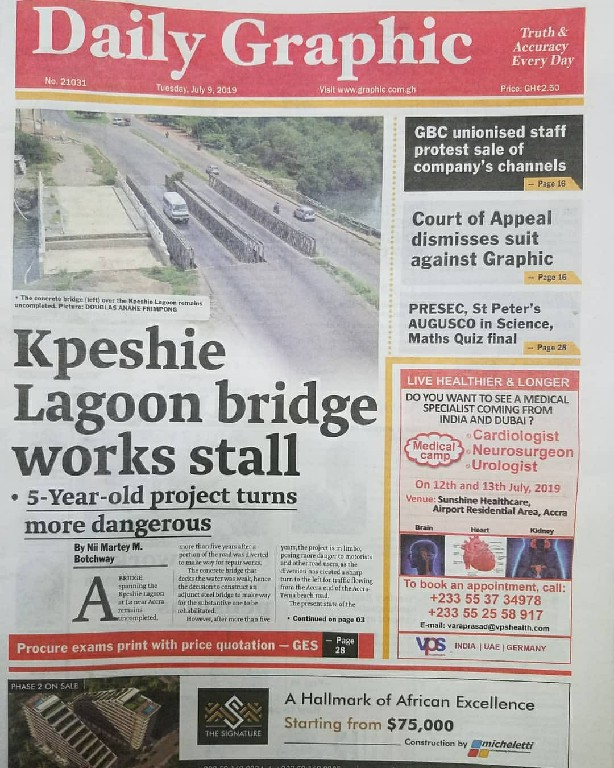
Newspaper Headlines Tuesday 9th July 2019

0

[ngg src=”galleries” ids=”84″ display=”basic_thumbnail”]

Russia to increase trade and economic cooperation with Africa

0

The Chairman of Russia’s State Duma, Viacheslav Volodin, has urged African leaders to use the enormous natural resources of their countries to vigorously pursue sustainable development.

That, he said, was how to escape under-development, economic dependency and neo-colonialism.

He added that, Russia was ready with a comprehensive plan to deepen its economic cooperation with Africa.

He was addressing the three-day Russia-Africa inter-parliamentary conference held in Moscow.

He said “it is necessary to prevent the revival of neo-colonialism, the destructive attitude towards the African resources.

“To achieve this, the sovereign right of African states to build their own future must be protected.

“Russia has always advocated and stands for the observance of international law on the basis of the principle of non-interference in the internal affairs of sovereign states.”

Mr. Volodin said both Russian and African parliamentarians would study issues concerning harmonization of legislations, so that trade between them would be guided by legislative norms.

It would be right, using the capability of parliaments, to “facilitate the establishment of contacts between Russian and African businessmen and the exchange of information on possible cooperation projects”.

He announced that a memorandum on cooperation between the Eurasian Economic Commission and the African Union would be signed soon.

This memorandum would bring Russian-African trade and economic cooperation to a higher level and accelerate the growth of bilateral trade.

“In 2018, the volume of trade with the African continent increased by 17.2 per cent in comparison with 2017 and amounted to $20.4 billion.

“This is a good indicator but this, of course, is not enough,” he noted.

Mr. Volodin said “the Russian Federation is interested in a mutually beneficial partnership with African states for the benefit of the wellbeing of our peoples – the peoples of Russia and the African continent”.

Director of the Institute for African Studies under the Russian Academy of Sciences, Professor Irina Abramova, spoke about the role of science in the development of cooperation between Russia and Africa.

She pointed out that “without a technological breakthrough in ecology, health and education, we are not able to break our relations free from the deadlock and solve the problems that both the Russian people and the people of Africa are facing”.

A former Special Presidential Representative to Africa, Professor Alexey Vasileyev, said the level and scope of Russian economic cooperation with Africa had doubled in recent years, “but Russian-African cooperation is not in the top five.”

He called for greater cooperation in the areas of agriculture, manufacturing, the financial sector, and information technologies in Africa.

For the past few years, Russian authorities have taken steady and strategic steps towards pushing huge investments in lucrative sectors to strengthen bilateral relations and expand economic cooperation in a number of African countries.

He urged African countries to make trade choices that were in their best economic interests and asked that Russia considered the removal of tariff and non-tariff restrictions on economic relations.

In order to increase trade, Russia has to improve its manufacturing base and Africa has to standardize its export products to compete in external markets.

He, however, acknowledged that Russia had few manufactured goods that could successfully compete with Western-made products in Africa.

The former Presidential Envoy said it was necessary to create free trade areas.

“But before creating them, we need information. And here I am ready to reproach the Russian side, providing few information to Africans about their capabilities, and on the other hand, reproach the African side, because when our business comes to Africa, they should know where they go, why and what they will get as a result.”

He said “Interestingly, there are few Russian traders in Africa and African exporters are not trading in Russia’s market due to multiple reasons including inadequate knowledge of trade procedures, rules and regulations as well as the existing market conditions”.

“The task before us, especially before the both parliaments, is to harmonize the norms of trade, contract and civil law.

“The parliamentarians of the two sides have the task to work together on a legislative framework that would be in the interests of both sides. This should be a matter of priority.”

Foreign Minister Sergey Lavrov has praised the legislators’ role in promoting the entire complex of Russian-African cooperation and welcomed steps towards intensifying contacts between the Russian Federal Assembly and African parliaments.

On October 24 this year, the Russia-Africa summit, first announced by Russian President Vladimir Putin during the 10th BRICS summit, would take place in Sochi.

Source: GNA

Congolese ‘Terminator’ faces war crimes judgment

0

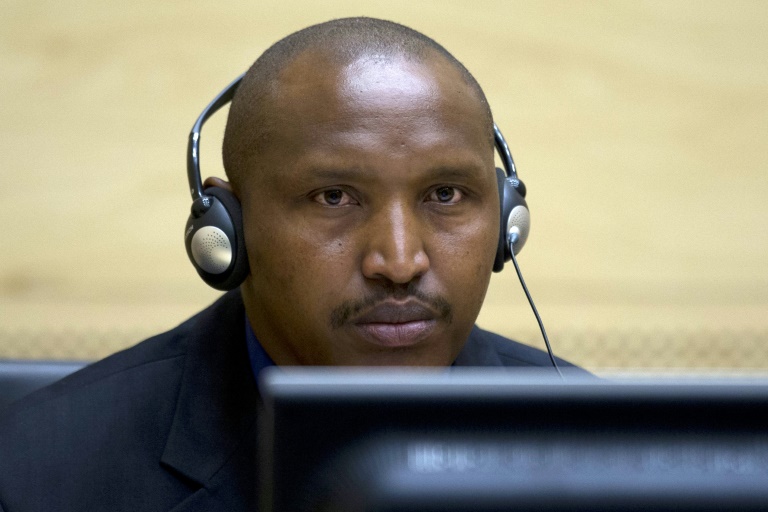
The International Criminal Court is on Monday to pass judgement on Congolese warlord Bosco Ntaganda, dubbed the “Terminator” for allegedly masterminding massacres and using children in his rebel army.

Ntaganda, 45, is accused of overseeing the slaughter of civilians by his soldiers in the Democratic Republic of Congo’s volatile, mineral-rich Ituri region in 2002 and 2003.

Prosecutors gave horrific details of victims including some who were disembowelled and had their throats slit, as part of the evidence during his three-year trial in The Hague.

The ICC says it will announce at 0800 GMT “whether it finds the accused innocent or guilty beyond reasonable doubt.”

The soft-spoken Ntaganda — known for his pencil moustache and a penchant for fine dining — told judges during his trial that he was “soldier not a criminal” and that the “Terminator” nickname did not apply to him.

Rwandan-born Ntaganda faces 13 counts of war crimes and five counts of crimes against humanity for his role in the brutal conflict that wracked the northeastern region.

Prosecutors portrayed him as the ruthless leader of ethnic Tutsi revolts amid the wars that wracked the Democratic Republic of Congo after the 1994 genocide of Tutsis in neighbouring Rwanda.

More than 60,000 people have been killed since the violence erupted in the region in 1999 according to rights groups, as militias battle each other for control of scarce mineral resources.

– High profile setbacks –

Prosecutors said Ntaganda was central to the planning and operations for the Union of Congolese Patriots rebels and its military wing, the Patriotic Forces for the Liberation of Congo (FPLC).

The FPLC killed at least 800 people as it fought rival militias in Ituri, prosecutors said.

Formerly a Congolese army general, Ntaganda then became a founding member of the M23 rebel group, which was eventually defeated by Congolese government forces in 2013.

The first-ever suspect to voluntarily surrender to the ICC, he walked into the US embassy in the Rwandan capital Kigali in 2013 and asked to be sent to the court, based in the Netherlands.

Ntaganda is one of five Congolese warlords brought before the ICC, which was set up in 2002 as an independent international body to prosecute those accused of the world’s worst crimes.

Ntaganda’s former FPLC commander Thomas Lubanga was sentenced to 14 years in jail in 2012.

But it has suffered several setbacks over recent years with some of its most high-profile suspects walking free, while it has also been criticised for mainly trying African suspects so far.

In a separate hearing on Monday, judges are to determine whether there is enough evidence for a Malian jihadist to face trial for demolishing Timbuktu’s fabled shrines, as well as for rape, torture and sex slavery.

Al Hassan Ag Abdoul Aziz Ag Mohamed Ag Mahmoud was captured and transferred to the court last year.


Source: AFP

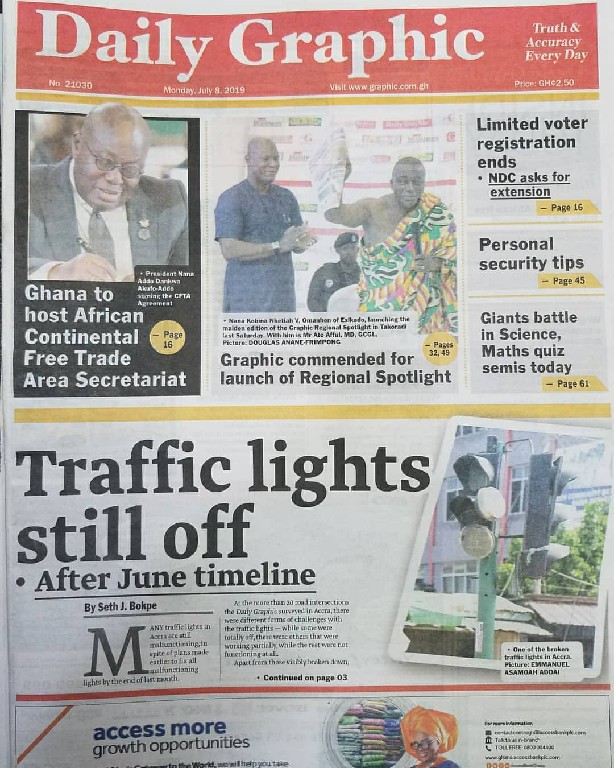
Newspaper Headlines Monday 8th July 2019

0

[ngg src=”galleries” ids=”83″ display=”basic_thumbnail”]

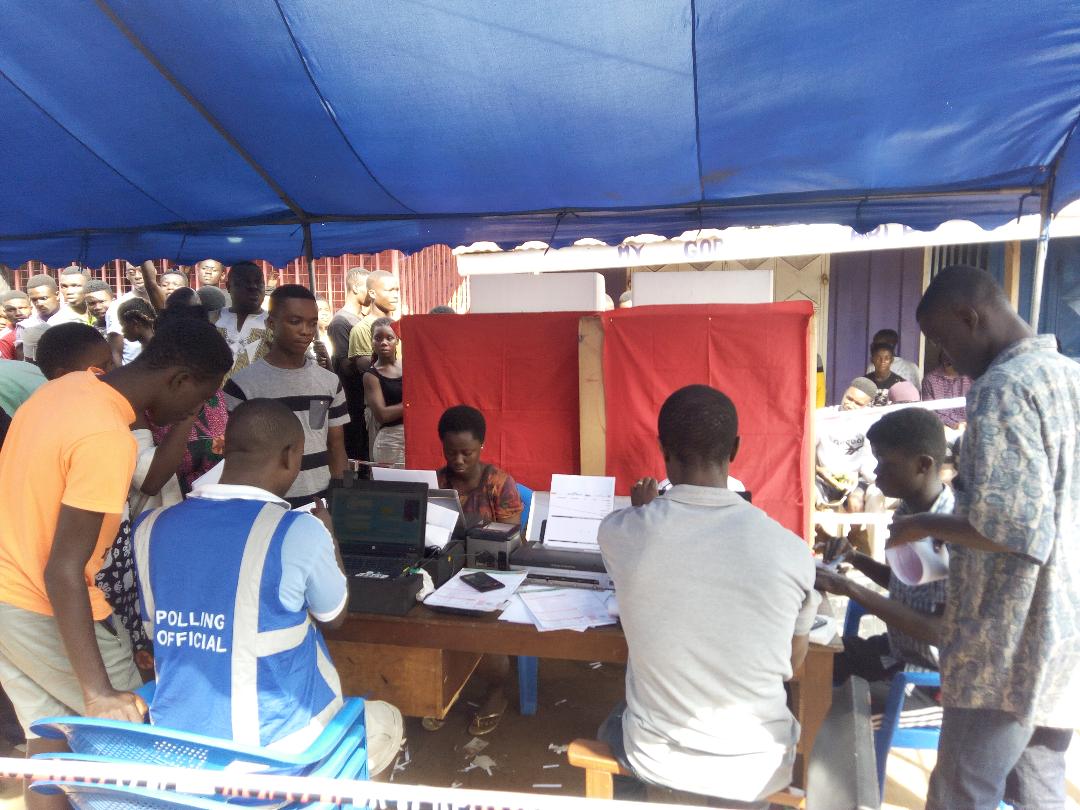
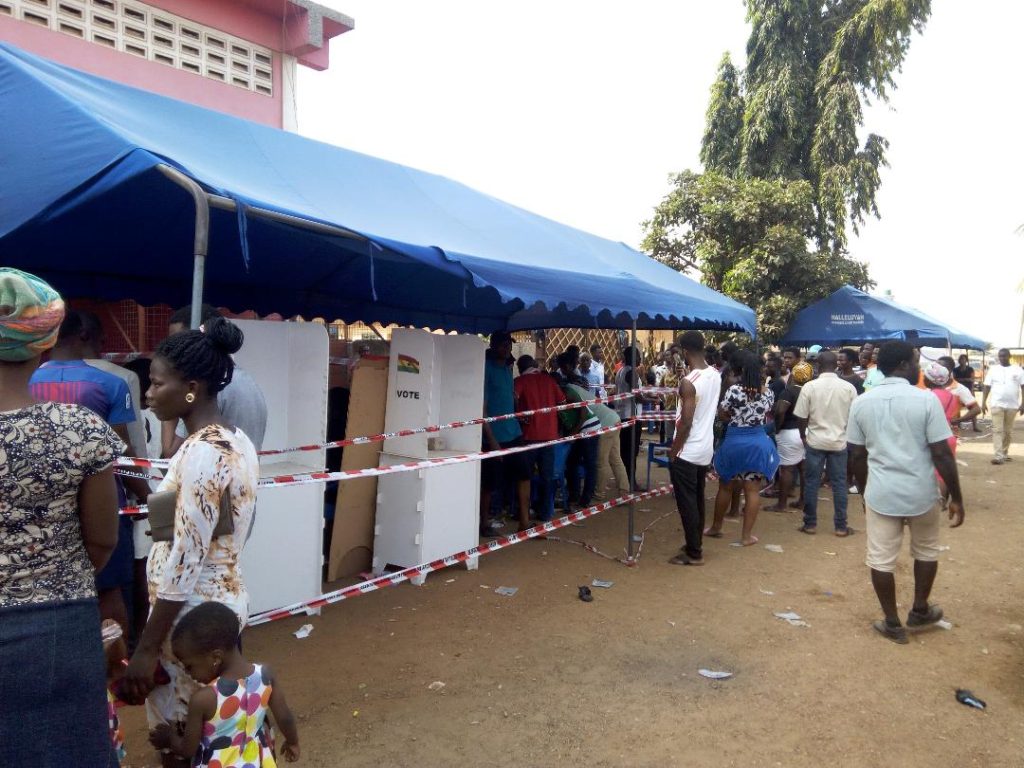
EC limited registration ends in Ashaiman

0

The two-week Electoral Commission’s (EC) limited voter registration exercise, which began on Monday June 17, ended peacefully at the Ashiaman District office on Sunday.

The exercise was enable citizens who have turned 18 and new registrants to have their names registered for the 2020 election.

Mr Stephen Reynolds, District Electoral Officer of the Commission for the Ashaiman District, told the Ghana News Agency (GNA) that the exercise had been generally smooth despite the rains over the week.

He said although there were some few network challenges on the first day the exercise over the period has been successful.

Mr Reynolds said all the four Registration Centres worked effectively without any physical or technical challenges despite the large numbers that flooded the centres each day from all the 17 electoral areas within the District.

“The exercise starts as early as 0700 hrs and closed by 1800 hrs each day; and we were able to serve all those who report each day within this stipulated time,” he said.

Mr Reynolds said that the exercise was not meant to replace missing cards and that those with such challenges had to wait for the EC to fix another time to attend to their challenges.

He commended the Ghana Police Service for their presence to ensure good security and the smooth running of the exercise, and representatives of the various political parties for their cooperation throughout the exercise.