Media companies are responsible for defamatory comments made on their Facebook pages, an Australian court said in a landmark ruling Monday.
The New South Wales Supreme Court ruled that three media companies were responsible for user comments on a story about an indigenous youth detainee, Dylan Voller, in 2016 and 2017.
Voller claimed that publishers of the Sydney Morning Herald, The Australian and Sky News were responsible for comments on their public Facebook pages — alleging he was a rapist and that he attacked a Salvation Army officer leaving the man blind in one eye.
His lawyers said the comments were defamatory.
Voller had been held in youth detention in the Northern Territories, and videos of him being mistreated by staff prompted a Royal Commission inquiry in 2016.
Lawyers for the media companies argued they could not be expected to filter the hundreds and thousands of comments posted on their Facebook pages day and night.
But, acknowledging the ruling related to an “emerging area” of law, the court found that the media companies could have screened or blocked defamatory comments.
The court considered cases from New Zealand to Hong Kong, and ultimately determined companies should pay costs and potential damages, but left the door open for appeal.
It did not rule on whether the comments themselves were defamatory.
The case raises questions about laws governing Facebook and other social media sites, notably, whether Australia’s already stringent defamation laws — which strongly favour those claiming defamation — have become even tougher.
“It could have far-reaching implications for media organisations using Facebook as a platform,” said lawyers at Addisons in a legal briefing paper.
If the final ruling goes against media companies, they “will need to monitor and remove any defamatory comments on their posts”.
The chief political correspondent at Nine — a television channel which now owns the Sydney Morning Herald — expressed unease at the “appalling trajectory of defamation law in Australia”, which he said represented a “real and present danger to journalism”.
The curtain came down on Paris men’s fashion Sunday with two high-concept shows that had walk-on roles for Solange and K-pop sensation Lisa.
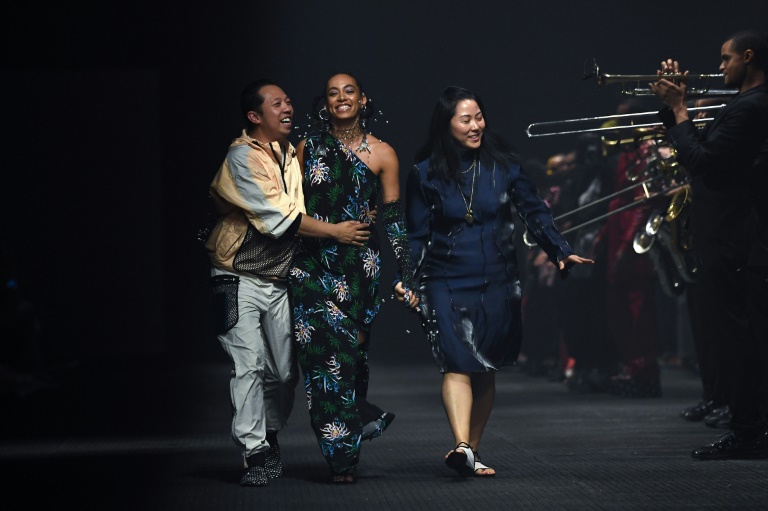
Kenzo’s design duo Carol Lim and Humberto Leon said goodbye to the French label with Solange as the surprise performer in the same Paris stadium which Elton John had packed to the rafters a few nights previously.
The Californians’ ended their eight-year reign with a bang as the American star appeared on a platform to sing “I’m a Witness” in between the men’s and womenswear lines.
Fashion designer Olivier Rousteing, acknowledges the audience at the end of the Balmain Men’s spring/summer 2020 fashion collection
The brilliantly choreographed event had started with a similar wow moment when a huge curtain was pulled away in front of 600 or so fashionistas to reveal several thousand more people on the other side.
Having conducted her 11-piece black-clad brass band, Beyonce’s younger sister then walked arm-in-arm with the designers to acknowledge the ovation at the end, with the feminist English rapper M.I.A in the front row.
Balmain’s Olivier Rousteing got the weekend rocking late on Friday night by making the hot French DJ Kiddy Smile the centre of his show-cum-concert.
– Real-life Japanese mermaids –
The young French creator — who often dresses big music stars for their tours — also threw open the doors by giving away 2,000 tickets.
“Everyone is talking about inclusivity from behind their screens but no one is actually doing something,” he told reporters.
Kenzo’s life aquatic: Inspired by female Japanese divers, the French brand summoned up an undersea mermaid world
Inclusion has been one of Lim and Leon’s watchwords, and their final Kenzo collection was inspired by Japanese Ama divers, the “sea women” who have been diving for pearls for 2,000 years.
Traditionally, the divers only wore a loincloth and the pair picked up that motif with rippling, silkily aquatic clothes that weren’t obviously sexy but were utterly sensual at the same time.
Men’s and women’s lines were peppered with gorgeously original fishing and mermaid metaphors, with a fluidity and a dreaminess about the clothes, particularly in the play with pearls, urchins and little touches of foaming silk and organza.
While Lim and Leon went out on a high, you could be forgiven for feeling that Hedi Slimane, Mr Rock Chic himself, was treading water somewhat.
The style superstar who is credited with the skinny look has taken a terrible kicking from critics since unseating the beloved feminist creator Phoebe Philo at Celine.
– Slimane’s retro flares –
He closed fashion week with another no-expense-spared show that began with an awesome theatrical device.
Dig the string vest, man: Celine’s men’s show was a retro ride back to early 1970s California rock chic
As for the clothes, the big news is that the “Sultan of Slim” has jettisoned his trademark drainpipes, the trousers the late Karl Lagerfeld once lost nearly 42 kilos (92 pounds) to fit into, for flares worn long over heeled boots.
Skinny though lives on in the rake-thin male models, every one wearing black aviator shades.
In fact, Slimane’s “Celine 04” collection was very much like a male version of “Celine 03” — a walk down memory lane.
This time it was a sometimes literalist re-creation of what American West Coast rock star types were wearing circa 1973, with a sharp couture sheen and added sparkles.
Tight leather jackets and flares, unbuttoned shirts and three-piece double breasted suits with white cowboy boots, red carnation button holes and long thin scarves.
– Fans scream for Lisa –
70s attitude: Hedi Slimane brought back the men’s open-necked shirt and necklace at the Celine Paris fashion how
Some tops carried downbeat slogans from New York artist David Kramer’s paintings such as “Yesterday was better”, “My own worst enemy” and “Downhill from here”.
You could not help but wonder if Slimane — whose army of loyal free-spending fans are known as “Slimaniacs” — was teasing his critics, with one of Kramer’s images carrying the caption, “…There is no irony here.”
New kid on the block: Lanvin played with every cliche of the French summer and seaside and somehow made them look new.
Fans did scream at the end but it was more for Lisa, the Thai-born rapper of Blackpink fame who is Slimane’s new “official muse” and who was in the front row.
There was much joy to be had elsewhere with the reinvigorated British brand Dunhill and Paul Smith, the doyen of English tailoring, showing there is plenty of creative life left in variations on the suit.
But the big breath of fresh air was the young French designer Bruno Sialelli confirming the promise of his debut collection for Lanvin with a show held at a swimming pool.
Quirky, cool, cute and a lot of fun to look at — and clearly to wear — Sialelli turned out a collection that played with every cliche of the French summer and seaside and somehow made them look new.
It was hard not to smile at his tricorne straw hats.
Ahoy, tricorne hat: Lanvin held their spring summer Paris fashion show in a swimming pool
Not for him the pasty, androgynous models that often dominate the Paris catwalk.
“I wanted the boys to eat well and to look healthy and strong,” he told AFP.
“Now I need a holiday, he added. “I mean, I love my work but holidays are the best things in life, no?”
Australia’s national broadcaster went to court Monday to challenge a police raid on its offices and demand the return of files seized during the controversial operation.
The Australian Broadcasting Corporation (ABC) demanded an injunction to prevent police from accessing the seized files, which concern a two-year-old investigative report on war crimes by Australian special forces in Afghanistan.
ABC managing director David Anderson said the suit also challenged the constitutionality of the search warrant used by police to conduct the raid “on the basis that it hinders our implied freedom of political communication.”
Agents of the Australian Federal Police (AFP) raided the ABC headquarters in Sydney on June 5 as part of investigations into the leak of the so-called “Afghan files” by a government whistleblower.
The warrant they used allowed the police to “add, copy, delete or alter” material found on the ABC’s computers related to the Afghan story.
That operation came a day after the AFP raided the home of a Canberra journalist and seized files and computer equipment over a year-old article on secret government plans to allow Australia’s main foreign intelligence agency to spy on Australians at home.
News Corp, the Rupert Murdoch-owned media giant which employed the Canberra reporter, said Monday that it was also preparing a legal challenge to the AFP search of her home.
The twin raids sparked widespread protests by the news media and civil libertarians here and abroad who accused Australia’s conservative government of undermining freedom of the press.
Critics were particularly concerned over the AFP’s refusal to rule out handing down criminal charges against journalists who publish reports based on leaked classified information.
Prime Minister Scott Morrison, whose government has implemented a series of controversial law-and-order measures in recent months, insisted there was no political involvement in the police investigations of the ABC and News Corp.
But he has insisted on the need to crack down on the leak of classified information.
Monday’s legal challenge coincided with the launch of a joint campaign by the ABC, News Corp. and the country’s other main commercial news company, Nine Entertainment, to demand the government pass laws to protect journalists and press freedom.
Unlike most Western democracies, Australia does not have a bill of rights or a constitutionally enshrined protection for freedom of speech.
It also has among the world’s strictest defamation laws, while courts routinely issue gag orders preventing the reporting of details of many legal proceedings.
“Australia has a creeping culture of secrecy,” lamented Michael Miller, head of News Corp Australia, in an editorial published Monday.
While acknowledging that journalists are not “above the law” and that threats to national security exist, Miller added, “we do not believe that the laws aimed at terrorists should sweep journalists up in their net.”
China said Monday it would seek backing for free trade and multilateralism at the G20 summit this week as it denounced protectionism while it fights a tariffs war with the United States.
A meeting between Xi Jinping and his Donald Trump on the sidelines of the gathering in Osaka, Japan has fuelled hopes for a truce in the increasingly damaging standoff between the world’s top two economies.
“Unilateralism and protectionism has damaged global growth… undermined global value chains and dampened market sentiment,” Zhang Jun, the Chinese assistant minister of foreign affairs, said at a briefing to preview Xi’s attendance at the summit.
“China will work with others at the G20 to firmly uphold multilateralism and an open, rule-based global trading order,” Zhang said.
But Japan, the European Union and other trading partners have in the past echoed US complaints about the alleged theft of intellectual property and lack of a level playing field for foreign investors in China.
Any attempts to build a united front with China will be tempered by these concerns.
Negotiations to resolve the trade war stalled last month resulting in both sides exchanging steep tariffs on hundreds of billions in exports.
Chinese vice minister for commerce Wang Shouwen said teams from both sides are now “discussing the next step for communication” ahead of the Xi-Trump meeting.
The two should make compromises and any talks between China and the US have to be based on “mutual respect, equality and mutual benefit and comply with WTO rules”, Wang said.
The two leaders are also expected to discuss the fate of Chinese tech giant Huawei, which has suffered a heavy blow after the Trump administration banned US firms from working with it, citing espionage fears.
Wang urged the US to remove “inappropriate and discriminatory” barriers against Chinese companies, saying such moves jeopardise the interests of both Chinese and US companies.
The planned meeting comes a week after Xi visited nuclear-armed North Korea, and analysts said any influence he may have on Pyongyang’s isolated leader could be used as leverage to win consensions from Trump.
Zhang declined to confirm whether North Korea will be on the agenda for the Trump-Xi head-to-head, saying they were still “finalising the details”.
He also said China will “not allow” a discussion on Hong Kong at the G20 even as Washington said Trump plans to raise the city’s mass protests in his meeting with Xi.
Trophies and personal souvenirs belonging to German tennis star Boris Becker will be auctioned online from Monday by British firm Wyles Hardy to partially clear the bankrupt champion’s debts.
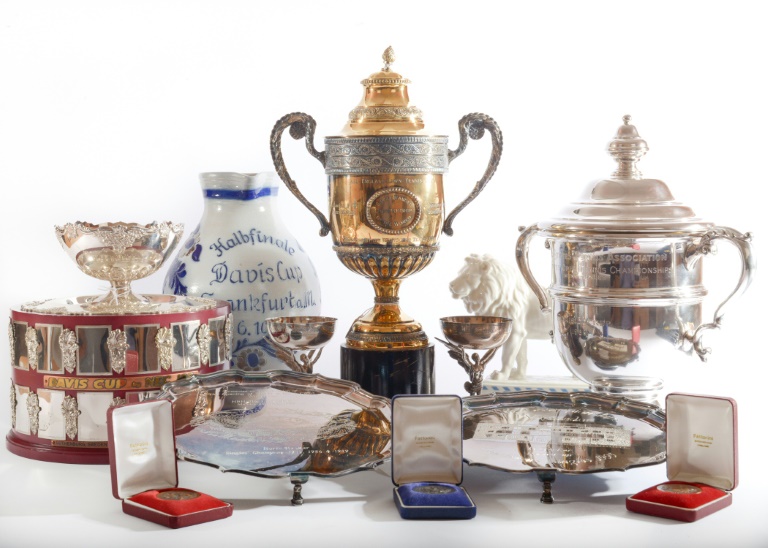
The youngest winner in Wimbledon’s history, who claimed the first of three titles aged just 17, is auctioning off 82 items including medals, cups, watches and photographs.
The sale will end on July 11, Wyles Hardy said on its website.
Some of the trophies up for grabs include a replica of a Challenge Cup awarded to Becker following one of his Wimbledon wins, and the three-quarter size replica of the Renshaw Cup presented after he became the youngest ever Grand Slam singles champion.
His Wimbledon finalist medal from 1990, when he was beaten by Swede Stefan Edberg, and a replica of the US Open silver cup made by jeweller Tiffany for his 1989 victory over Ivan Lendl, will also be included in the sale.
The indebted 51-year-old champion was declared bankrupt in 2017.
Boris Becker now focuses on his tennis activities, particularly commentating, as he attempts to use his fame to wipe out his debts
In June 2018, he claimed he had diplomatic status and therefore immunity, thus stopping the sale of his trophies and personal souvenirs at the last minute.
The former world number one claimed that he had been appointed by the President of the Central African Republic as a sporting, cultural and humanitarian “attache” to the European Union.
But the Central African Ministry of Foreign Affairs replied that the passport brandished by Becker was a fake one, coming from a batch of “blank passports stolen in 2014”.
– ‘Very substantial bids’ –
Becker finally ended this bizarre episode in December by waiving his right to immunity in a London court specialising in insolvency cases, leading the auction house to put the trophies back on the market.
The six-times Grand Slam winner, nicknamed “Boom Boom” Becker for his devastating serve, won 49 titles and more than 20 million euros in prize money during his career
The first attempt “attracted very substantial bids,” Mark Ford, one of the three trustees of Becker’s bankruptcy estate, said in a statement.
However, the sales will not be enough to cover debts valued at millions of pounds.
Becker has already had legal difficulties with the Spanish courts over unpaid debts for work carried out on his villa in Mallorca.
The pastor who married him in 2009 also took him to court in Switzerland and the German courts in 2002 gave him a two-year suspended sentence and a fine of 500,000 euros ($570,000) over 1.7 million euros in unpaid taxes.
The six-times Grand Slam winner, nicknamed “Boom Boom” Becker for his devastating serve, won 49 titles and more than 20 million euros in prize money during his career.
He now focuses on his tennis activities, particularly commentating, as he attempts to use his fame to wipe out his debts.
Defiant fans are preparing to mark 10 years since Michael Jackson’s death as fascination with the King of Pop remains undimmed despite lurid claims of child sex abuse.
On Hollywood’s Walk of Fame, the singer’s star continues to draw a constant scrum of selfie-snapping tourists, while nearby souvenir shops, street performers and even tattoo parlors report a brisk trade in all things Jackson.
Across the street at Ripley’s Believe It Or Not museum, a statue of the singer is strategically perched above the box office to entice tourists. Staff at Madame Tussauds say Jackson’s waxwork remains a top draw.
Yet according to the groundbreaking HBO documentary “Leaving Neverland,” released earlier this year, it was just a few hours’ drive from the heart of Hollywood that Jackson used his celebrity and glamor to molest young boys at his fairytale-themed ranch.
While most fans who spoke to AFP were aware of the documentary, the adoration fostered from growing up with the “Thriller” megastar’s many hits supersedes all else.
Michael Jackson memorabilia is on display for sale at Times Square in New York City
“I came here actually only for him. I don’t take pictures with any other star,” said Dutch tourist Hooman Nazemi.
“Some stuff that they were saying in the doc was kind of hard, but you cannot say 100 percent it’s true … I just love him. I love him and I think everybody does.”
Antoine Baynes, 31, a Jackson impersonator who moonwalks along Hollywood Boulevard for tourists’ tips, said the allegations had done nothing to diminish his performances’ appeal — in fact, the opposite.
“After the HBO special came out I received just as much if not more attention than before. It kinda gave it publicity,” he said.
“Honestly I’ve married people as Michael Jackson. I have two weddings to do this Sunday, to do as Michael Jackson!”
– ‘Love Rally’ –
The claims in the HBO documentary by two men who say Jackson sexually abused them for years as minors were not the first, but reignited the scandal after the star’s fatal overdose at age 50 in 2009.
In his lifetime, Jackson denied all child sex allegations and his estate filed a $100 million lawsuit against HBO for “posthumous character assassination.”
In his lifetime, Jackson denied all child sex allegations and his estate filed a $100 million lawsuit against HBO for “posthumous character assassination”
On Tuesday, the anniversary of Jackson’s passing, die-hard fans from around the world have planned an “MJ Innocent Love Rally” through Hollywood to gather at his star on the sidewalk.
Other events include a “zombie dance” on Venice Beach and screenings of fan-made tribute films.
Those who cannot attend are invited to donate money for an annual ceremony placing roses by Jackson’s grave in the nearby Forest Lawn cemetery.
Organizers did not respond to a request for comment, but claim on Twitter that a record of more than 18,000 roses have been bought this year.
Yet numbers signing up to the events’ Facebook pages are conspicuously low, and pro-Jackson messageboards are rife with complaints about the lack of mainstream enthusiasm for anniversary events this year.
If the controversy has dampened commemorations — with Variety reporting that TV networks and producers have pulled the plug on long-planned anniversary programs — Jackson’s commercial clout remains substantial.
T-shirts, keyrings and coasters bearing the singer’s likeness remain on prominent display at Hollywood tourist stores lining the boulevard, outnumbered only by images of Elvis Presley and Marilyn Monroe.
Of a dozen such shops visited by AFP, only one had removed Jackson memorabilia from its shelves, citing a decline in interest.
And for some die-hard fans, a throwaway souvenir just won’t cut it.
“We get people asking for the silhouette, with the hat, sometimes his signature,” said tattoo artist John Lopez.
“Maybe five or six each year. It’s no different this year.”
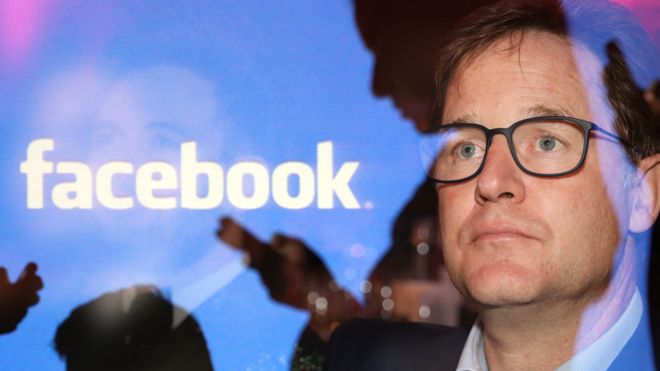
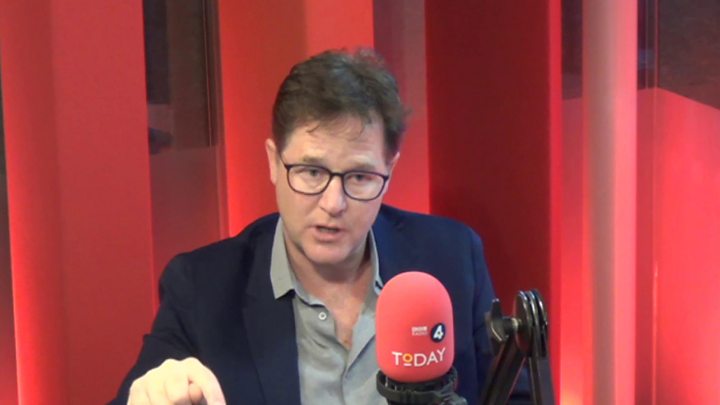
There is “absolutely no evidence” Russia influenced the Brexit result using Facebook, the company’s vice-president, Sir Nick Clegg, has said.
The former deputy PM told the BBC the company had carried out analyses of its data and found no “significant attempt” by outside forces to sway the vote.
Instead, he argued that “the roots to British euroscepticism go very deep”.
In a wide-ranging interview, Sir Nick also called for more regulation of Facebook and other tech giants.
Sir Nick, the former leader of the Liberal Democrats and deputy prime minister during the coalition government, was hired by Facebook in October last year.
In an interview with BBC Radio 4’s Today programme, he said Facebook was now arguing for greater regulation of tech firms.
He said there was a “pressing need” for new “rules of the road” on privacy, election rules, the use of people’s data and adjudicating on what constitutes hate speech.
It follows growing criticism of the tech giant and calls from MPs for far stricter regulation over issues including fake news, harmful content and the way user data is used.
Asked whether Facebook should not be fixing some of these issues itself, Sir Nick said it was not something big tech companies “can or should” do on their own.
“It’s not for private companies, however big or small, to come up with those rules. It is for democratic politicians in the democratic world to do so,” he said.
But he stressed companies like Facebook should play a “mature role” in advocating – rather than shunning – regulation.
Deputy Labour leader Tom Watson tweeted that Sir Nick’s proposed remedy of an oversight committee was inadequate.
Listening to Nick Clegg on the @BBCr4today answer for the dystopian world of Facebook – from live-streaming massacres to enabling suicides. Zuckerberg hired a former deputy PM so he could “understand Europe.” His proposed remedy? An oversight committee. Pull the other one.
In the interview, Sir Nick dismissed claims that data analytics firm Cambridge Analytica influenced people’s decision to vote Leave in the EU referendum in 2016.
Sir Nick Clegg tells Today that “the roots to British euroscepticism go very deep”
“Much though I understand why people want to sort of reduce that eruption in British politics to some kind of plot or conspiracy – or some use of new social media through opaque means – I’m afraid the roots to British Euroscepticism go very, very deep,” he said.
Instead, he argued attitudes had been influenced far more by “traditional media” over the last 40 years than by new media.
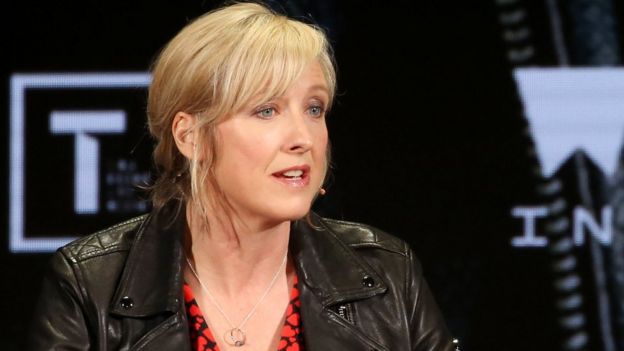
The scandal around the way data was used by Cambridge Analytica was first exposed by Carole Cadwalladr, an investigative journalist at the Guardian newspaper.
Guardian journalist Carole Cadwalladr exposed the Cambridge Analytica data scandal
Christchurch attack video
Sir Nick also claimed the company was getting better at removing harmful content, saying it was a “matter of minutes” before the first video of the Christchurch mosque shooting was removed.
A video of March’s attack, in which 51 people were killed, was livestreamed on Facebook.
The issue, he said, was the huge numbers of people reposting that initial video afterwards, including the mainstream media.
“In the case of Facebook, I think 200 people saw the video as it was being livestreamed,” he said.
But in the 24 hours following the shooting, Sir Nick said Facebook took down 1.5 million versions of the video. He said about 1.3 million of those were removed before they were reported.
Self-harm images
Sir Nick was also asked about how well Instagram – which is owned by Facebook – was responding to images of self-harm on the platform.
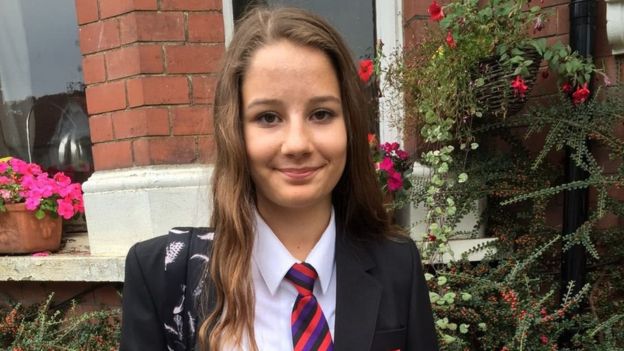
After 14-year-old Molly Russell took her own life in 2017, her family found distressing material about depression and suicide on her Instagram feed.
Sir Nick said Instagram had spent a lot of time with experts on teenage mental health and had been told it was “important to allow youngsters to express their anguish”, including allowing them to post images of self-harm.
Molly Russell died in November 2017
“We have now shifted things dramatically. We take down all forms of graphic content. The images that are still available on Instagram have a sort of filter, if you like, so they can’t be clearly seen,” he said.
On wider attitudes towards the sector, Sir Nick said there had been a shift in recent years from “tech utopia” – where people like Facebook’s Mark Zuckerberg “could do no wrong” – to a culture of “tech phobia”.
But he cautioned against any excessive backlash against technology: “I think we end up with the risk that we throw the baby out with the bathwater and make it almost impossible for tech to innovate properly.”
“Technology is not good or bad,” he said. “Technology down the ages is used by good and bad people for good and bad ends.”
Facebook’s recent enthusiasm for regulation marks a bit of a contrast from Mark Zuckerberg’s previous refusals to meet with UK politicians on the subject of the spread of fake news and inappropriate content.
Having once dismissed the notion that Russia used Facebook to try to interfere with the US Presidential election in 2016 as “a pretty crazy idea” Zuckerberg was forced to backtrack when it became apparent that state actors were indeed at work posting material deliberately designed to divide opinion.
The tech giant now realises that regulation is inevitably coming its way, and perhaps feels it’s more strategic for it to be as involved as it can be in the creation of any new rules and whichever body would enforce them.
There are many examples of occasions when Facebook has failed to self-police – no small feat with 2.3 billion users posting their own material in real time – and by playing ball with national or international regulation perhaps it absolves itself of some of that heavy responsibility.
It’s a normal morning at a busy north-east London cafe.
Cutlery clinks as people eat and chatter with those on neighbouring tables and children shout greetings as friends from school come through the door.
But Eggs & Bread in Walthamstow is not your usual brunch spot.
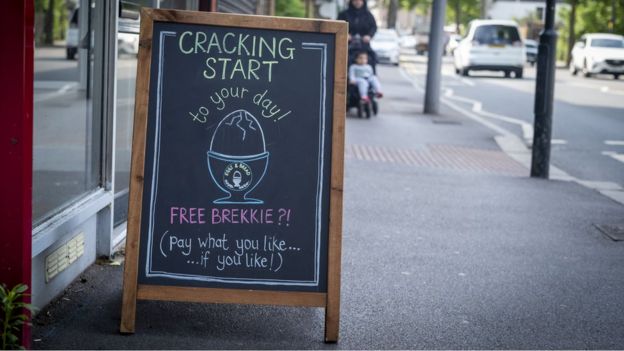
Customers can sit down, enjoy a hearty breakfast and walk out – without paying.
The project is one of dozens of not-for-profit “pay-what-you-like” cafes popping up across the UK.
Customers are asked to donate as much as they like – or are able – when they visit.
And if they can’t pay? No problem.
Outside Eggs & Bread, a sign boasts it offers the shortest menu on the street – just boiled eggs, toast and porridge, with tea, coffee and orange juice to drink.
Those that can afford to are asked to pop their money into the discreet “contributions” box mounted on the wall, so no-one ever really knows how much others have paid – or not paid.
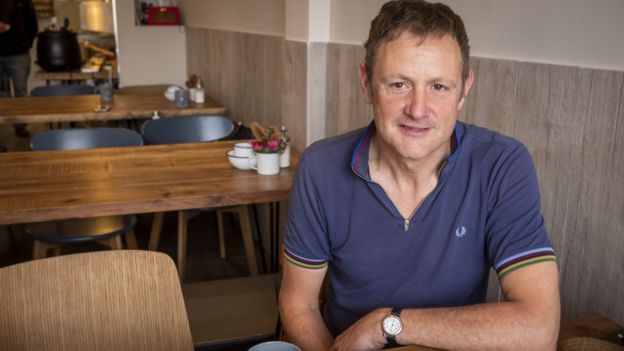
“If you are a City broker or simply broke – everyone’s welcome,” said owner Guy Wilson.
“Whether you’re catching up with friends, or just want somewhere comfy to grab a bite, we’re here, and at no charge.”
Simon Pemberton: ‘It’s almost like being on holiday, there’s such a nice vibe’
Guy, who works in insurance, has decided not to run Eggs & Bread as a charity, but as a not-for-profit business.
The cafe, he insists, is an “equaliser” allowing people from all walks of life to sit down and talk to one another over a good breakfast by “taking money out of the situation”.
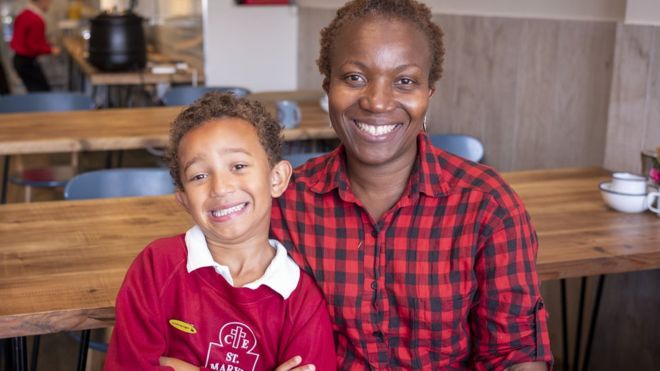
Regular Sheilla Addy-Tely, an author, pops in two or three times a week with her son Ethan, six, before school.
“Sometimes we come because it’s the easy breakfast option, sometimes finances are a bit stretched and when we can we make it up,” she says.
“I enjoy it so much and we’ve both made friends.”
“Are we going to pay today, mummy? I think we should,” Ethan cheekily interjects.
Sheilla laughs and confirms they will indeed be paying.
How much for a boiled egg and soldiers?
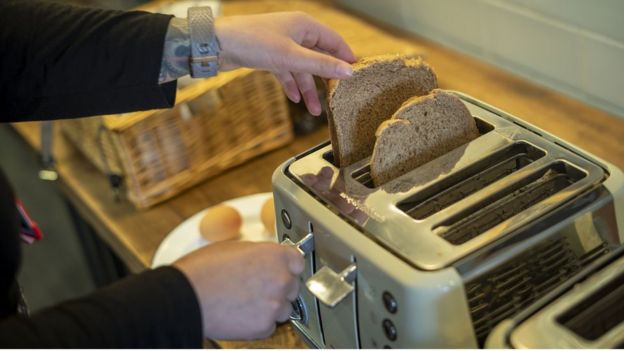
The cafe is also unusual in that customers serve themselves – they grab an egg (or two) from a basket, along with an egg timer, and place them in a specially built rack.
They toast their own bread and make themselves drinks – a process particularly appealing to the many children who visit.
Illustrator Louise Pemberton visits the cafe regularly with her husband, Simon, also an illustrator, and their two children.
“We’ve been coming here for the last four months or so, about three times a week,” she says.
“It’s almost like being on holiday, there’s such a nice vibe and everyone is so friendly,” Simon added.
The clientele is an unusual mix of parents popping in with their children before school, elderly people, professionals, adults with special needs and those who just fancy a chat.
Communal tables ensure people sit side by side with strangers and more often than not, conversations ensue.
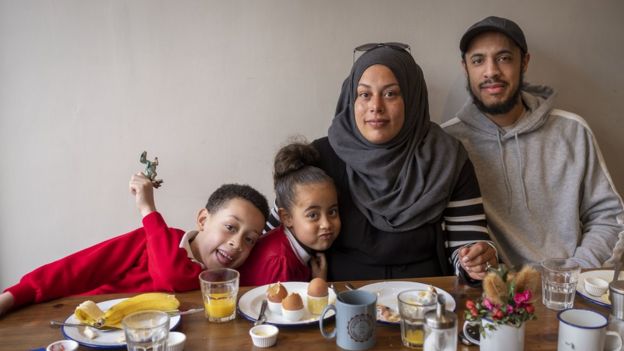
Juma Dimmock brought her husband, Warren, and children Rayyaa and Khalid along for the first time after she attended a coffee morning at the venue.
“It’s the first time we’ve all come here, but we thought we would try it out,” she says.
“It’s really nice and so handy as their school is really close by.
“Normally Khalid won’t eat eggs at home but he has today – we will definitely be coming back.”
Others visit the cafe as a chance to catch up and have a chat, like regulars Julie and Kate.
“We really like it here,” says Julie. “The people who work here are lovely and it’s always so clean.”
Juma Dimmock brought her family to the cafe
Elsewhere, projects have been set up to help people struggling to put a meal on the table or for environmental reasons.
Many use donated foods from supermarkets, restaurants and suppliers that would otherwise have gone to waste.
The Real Junk Food Project, based in Wakefield, offers “pay-what-you-like” cafes selling food that would have been thrown out.
It wants to end food waste, with owner Adam Smith stressing its mission is “environmental rather than social”.
Set up in 2013 as a single cafe, it now has sites across the country, including Glasgow and Manchester.
It also runs the Kindness Sharehouse in Wakefield, the world’s first “food intercepting” social supermarket.
It has “intercepted” 5,000 tonnes of food that would have been waste, the equivalent of 11.9m meals, and inspired more than 120 other concepts around the world.
The organisation works with 92 stores to make tonnes of food available on a pay-what-you-can basis.
Mr Smith decided to act after witnessing the amount of food waste generated by both farms and restaurant kitchens.
“But the Real Junk Food Project will only be a success when we are no longer needed,” he says.
Kitty Ward works at Eggs & Bread
At ToastLoveCoffee in Leeds, all ingredients are donated from local shops and supermarkets and would have been otherwise wasted.
There are no prices on the menu – and skills and time are accepted as currency instead of cash.
And in south London, Brixton Pound Cafe uses surplus food to create vegetarian and vegan meals for “everyone, regardless of situation”.
The cafe was opened in July 2016 as a direct response to “the rampant regeneration of the area”.
In 2018 the cafe saved 3.2 tonnes of food from landfill, by serving 11,000 meals to 18,500 customers, and collaborated with 35 local organisations to increase access to affordable healthy food for residents.
Adam Smith set up the Real Junk Food Project after witnessing waste in food production
“We aim to provide a relaxed and inclusive environment for locals looking for an alternative to expensive, exclusive establishments in Brixton,” says manager Sean Roy Parker.
Back at Eggs & Bread, owner Guy Wilson says: “What we are basically doing is providing the community with facilities to provide for itself.”
At the moment he funds the project and pays staff wages but hopes that within a year it will be self-sustaining.
As part of that, the cafe now runs a weekly chilli night where proceeds go towards the breakfast scheme.
“Of course, if the community doesn’t want to look after itself, this will fail – but I don’t believe it will,” he adds.
A £100m fund has been established to help UK firms capitalise on the boom in offshore wind.
With the UK so well suited to exploiting wind power, turbines have been erected in more than 30 locations from Brighton to the Moray Firth.
But trade unions say the boom has not generated enough jobs for UK workers.
The Offshore Wind Industry Council says its initiative will help hundreds of firms “maximise opportunities” in the offshore wind supply chain.
“The Offshore Wind Growth Partnership will provide practical help for UK companies so they can compete successfully for contracts in this thriving global market,” said Benj Sykes, chairman of the OWIC and UK country manager for the Danish firm Orsted.
The OWIC, which is a joint government and industry body, will invest the privately-raised funds over 10 years to support companies in the supply chain.
Firms that manufacture parts, lay cables and maintain wind farms will receive support ranging from “expert advice on manufacturing and commercialisation” to funding for innovation. They will also be given support to export their products and services.
By 2030 the offshore wind power market is expected to be worth £30bn per year, with the UK expected to be generating a third of its electricity from wind. The OWIC hopes to raise the participation of UK businesses in the industry from 48% currently to 60%, under a sector deal agreed between industry and government.
The new fund will bring “investment, thousands of high-quality jobs and huge economic opportunities for communities across the UK”, energy and clean growth minister Chris Skidmore said.
Last month GMB general secretary, Tim Roache said Britain’s politicians needed “to sharpen their elbows in the fight for jobs” when it came to opportunities in the growing renewables sector.
Scientists from round the world are meeting in Germany to improve ways of making money from carbon dioxide.
They want to transform some of the CO2 that’s overheating the planet into products to benefit humanity.
They don’t claim the technology will solve climate change, but they say it will help.
Carbon dioxide is already being used in novel ways to create fuels, polymers, fertilisers, proteins, foams and building blocks.
Until recently, it was assumed that energy-intensive firms burning gas to fuel their processes would need eventually to capture the resulting carbon emissions and bury them underground.
This option is inefficient and costly, so the prospect of utilising some of the CO2 as a valuable raw material is exciting for business.
Katy Armstrong, manager of the Carbon Utilisation Centre at Sheffield University, put it this way: “We need products for the way we live – and everything we do has an impact.
“We need to manufacture our products without increasing CO2 emissions, and if we can use waste CO2 to help make them, so much the better.”
Many of the young carbon usage firms are actually carbon-negative: that means they take in more CO2 than they put out.
We visited three pioneering businesses in the UK which are already making money out of CO2.
Here are their recipes for success (or at least, the ones they will share with us).
Three success stories
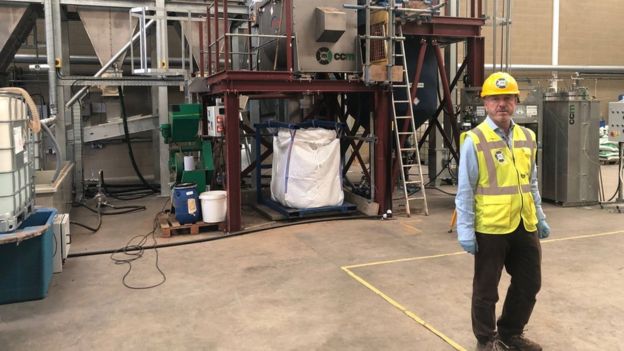
CO2 to fertiliser: CCm Technologies, Swindon
Fertiliser plants like this one using CO2 in Swindon can help solve the problem
Recipe: Put cow dung and maize into a bio-digester, where bacteria break them down and produce biogas to heat our homes.
Mix the left-over sludge with nutrient-rich wastes from the fertiliser industry, sewage plants, farms or the food industry.
Pump in CO2, which helps the nutrients bind to the sludge.
Product: High-grade fertiliser pellets that have soaked up more CO2 than they produced. The technology has already won export orders.
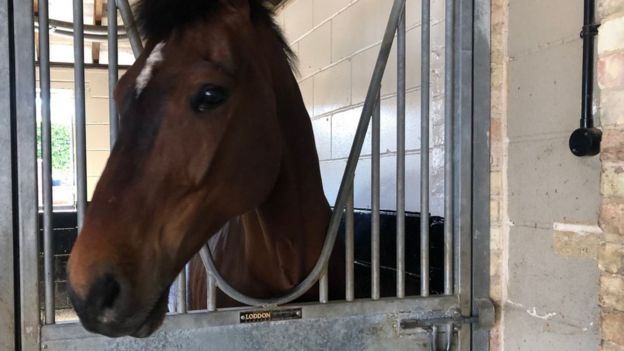
CO2 to beer bubbles: Strutt and Parker Farms, Suffolk
Can this beauty put the fizz in your lemonade?
Recipe: Take horse muck and straw from Newmarket races. Put the smelly mess through a bio-digester (as above).
Extract biogas and CO2. Using advanced membranes, separate out food grade CO2.
Product: Clean CO2 that’s sold to a local brewery to put the fizz into lemonade and lager.
CO2 to building blocks: Carbon 8 Aggregates, Leeds
Bio-digester processing horse manure in Suffolk
Recipe: Take ash from the chimney of a waste incinerator plant.
Mix in water and CO2 – then stand back… this procedure gets very hot.
The CO2 is permanently captured within the waste ash to form artificial limestone for building blocks and other purposes.
The process has the additional benefit of treating the ash that would otherwise be sent to landfill.
Product: blocks that have locked up CO2, whilst also reducing the need for carbon-intensive cement. The technology is winning exports.
These firms are pioneers in what’s known as the Circular Economy, in which wastes are turned into raw materials. The EU is trying to prompt all industry to adopt this principle.
How much CO2 can products absorb?
The big question is how much of the approximately 37 gigatonnes of CO2 emitted annually from our homes, cars, planes, offices and industries can be utilised by industry.
One report projected that seven gigatonnes a year of CO2 could be locked up into new products.
Katy Armstrong described this figure as hugely optimistic. But she said: “Every tonne that’s captured is a tonne that doesn’t heat the atmosphere, so let’s hope the industry thrives.”